
DISCOVER THE FUTURE OF ACADEMIC PUBLISHING
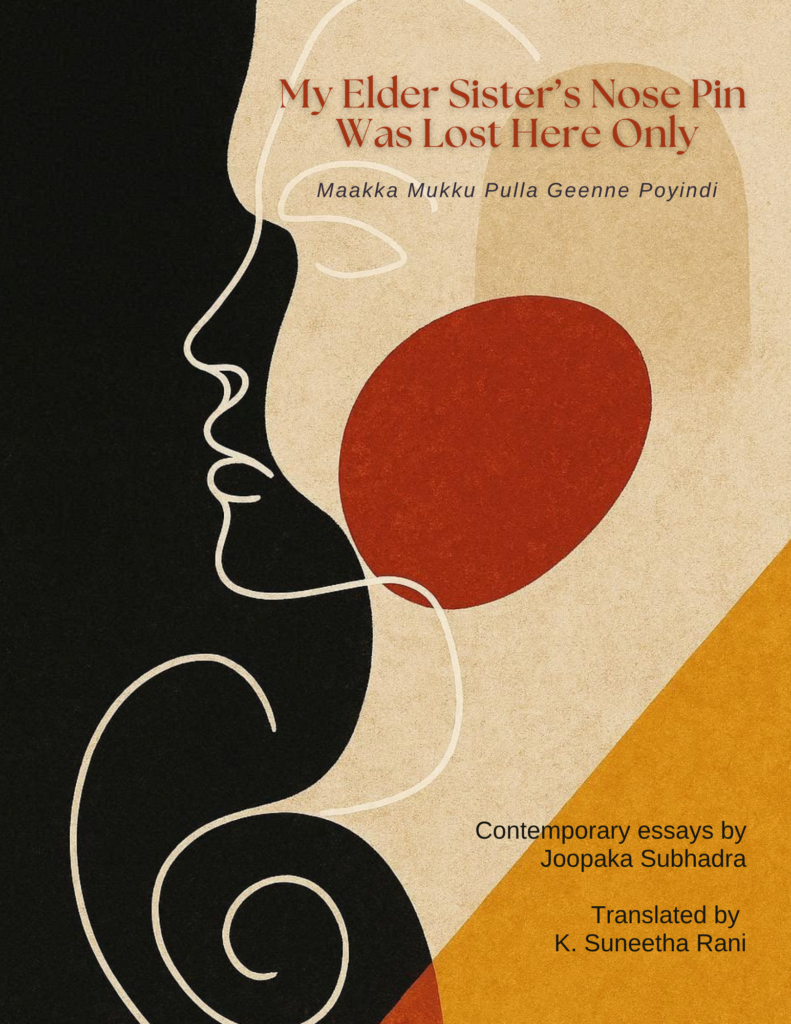
RUPKATHA BOOKSMy Elder Sister’s Nose Pin Was Lost Here Only: A translation of Joopaka Subhadra's Maakka Mukku Pulla Geenne Poyindi by K. Suneetha Rani
Bibliographic Details
- Publisher: Rupkatha Books (Imprint), Aesthetix Media Services (OPC) Private Limited; First edition (06 June 2026), under Rupkatha Translation Project 2025
- Language: English
- Ebook: 214 pages
- ISBN-13: 978-81-975130-0-8
- DOI: https://doi.org/10.21659/rtp02 [to be assigned]
- PDF Link: Free Access
- License: CCNC
- Dimensions: 21.59 cm x 27.94 cm
- Country of Origin: India
About the Book
This English translation of Joopaka Subhadra’s My Elder Sister’s Nose Pin Was Lost Here Only (Ma Akka Mukku Pulla Geenne Poyindi) by K. Suneetha Rani emerges from a pressing need to re‑examine the economic, cultural, political and philosophical inheritances that dictate and control our understanding of Dalit identity and representation. Originally published as a monthly column in Bhumika Streevada Patrika (2007–2015), these writings confront the realities of caste, patriarchy, and regional marginalisation and interrogate the dynamics of power that produced such erasures. The title of the collection of essays owes its origin to a game played by children and village women, which would start with: “My elder sister’s nose pin was lost here only. Search where it was lost. Search how it was lost.” Here, “My elder sister” stands for the women of previous generations, while nose pins symbolise a prosperous, empowered cultural and theoretical stance for women.
The translation project by K. Suneetha Rani is sustained by a triadic principle of excavation, reconstruction and reclamation. Excavation involves retracing the fragments of cultural memory spread across the cultural texts, songs, myths, and philosophical motifs. Reconstruction requires reassembling these fragments into a clear canvas that brings to the fore contemporary struggles for recognition, equality, and justice. With these, it seeks to reclaim silenced histories and imagine futures grounded in the dignity of forgotten inheritances.
The collection primarily deals with the question of representation, how women, particularly those from marginalised communities, have been depicted, silenced, or mythologised in literature and cultural discourse. Figures such as Savitribai Phule, Ramabai Ambedkar, Sadalakshmi, and Phulan Devi are also remembered as icons whose lives continue to inspire. Subhadra situates their legacies alongside contemporary battles, showing how past and present are bound together in the ongoing fight for dignity and equality. She is acutely aware of the intersectionality involved in women’s representation and shows how oppression operates through overlapping structures by linking caste, class, gender, sexuality and religion.
Ultimately, this book invites all to participate in the ongoing dialogue about memory, representation and justice. It proves that the humanities remain vital precisely because they help us grapple with the unfinished business of history, and because they offer tools for imagining more equitable futures. In this, it turns into a manifesto of resistance and a call to rethink democracy through the eyes of the oppressed. My Elder Sister’s Nose Pin Was Lost Here Only offers a searing journey into the politics of caste and gender in contemporary India.
About the Author
Joopaka Subhadra is a Dalit womanist writer and activist who has published extensively in Telugu, including essays, columns, short fiction, and poetry. She has edited anthologies, translated fiction into Telugu, and served on the editorial committees of various journals and magazines. Her works include Ayyayyo Dammakka, a collection of poems (2009); Rayakka Manyam, a collection of short stories (2014); Charitralni Cherigipostu, a collection of essays on literary criticism (2021); Reservation Bogie, a collection of short stories (2021); Telangani Kaitala Donthulu, a collection of poems (2024). Subhadra has translated the Tamil Dalit writer Bama’s book Sangati into Telugu as Sangathi. She was honoured with almost 40 awards, including the Best Writer Award from the Telangana State Government. She has been writing a column titled Gunugupulu in the Sunday Supplement of the Telugu daily Andhra Jyothi since July 2023. My Elder Sister’s Nose Pin was Lost Here Only is the English translation of a column titled Ma Akka Mukku Pulla Geenne Poyindi, written by Joopaka Subhadra for Bhumika Streevada Patrika, a Telugu feminist monthly journal, from 2007 to 2015. The column is a critical commentary on various issues related to society, politics, and movements, but focusing on the marginalised identities such as caste, gender, and region.
About the Translator
K. Suneetha Rani is a Professor at the Centre for Women’s Studies, University of Hyderabad. Currently, she is the Dean of the School of Social Sciences. She was with the Department of English for 16 years before joining the Centre for Women’s Studies in 2011. Her areas of interest include Gender Studies, Cultural Studies, Comparative Studies, New Literatures in English, Translation Studies and Feminist Pedagogy. Her PhD in English Literature is on Australian Aboriginal Women’s Autobiographies. She translates from Telugu to English and English to Telugu. She has extensively published research articles and translations in English and Telugu. Her major publications in English include Australian Aboriginal Women’s Autobiographies: A Critical Study (2006), Flowering from the Soil: Dalit Women’s Writing from Telugu (Translation of Dalit Women’s Select Writings from Telugu) (2012), English in the Dalit Context (co-editor) (2014), Vibhinna: Voices from Contemporary Telugu Writing ((co-editor) (2015), A House on the Outskirts and Other Stories (Translation of Devarakonda Balagangadhara Tilak’s select short fiction from Telugu)(2016), Influence of English on Indian Women Writers: Voices from the Regional Languages (2017), Identities and Assertions: Dalit Women’s Narratives (2017), The Rock That Was Not (Translation of Githanjali’s Select Short Fiction from Telugu) (2019), Critical Discourse in Telugu (2021). Her book-length translations into Telugu include Neeli Needa: Australia Adivasi Ammayi Atmakatha; Daarulu: Tappinchukune Daarulu, and Dweeparagalu: Srilanka Strila Sahityam. She is the editor of Gender Handbooks in Telugu and English for teachers and students of 6-8 and 9-12 classes assigned by Samagra Shiksha, Telangana and funded by UNICEF. She is the President of the Executive Committee of Bhumika Women’s Collective, Hyderabad, a non-profit organisation working against gender-based violence. She has recently completed a research project on gender assumptions among adolescent boys, assigned by the Department of Education, Government of Telangana, and funded by UNICEF, Telangana.
Get In Touch
Rupkatha Books, a leading academic publisher, invites you to submit your book proposal for open access publication. We are dedicated to advancing scholarship by releasing high-quality books that are meticulously curated and freely accessible to ensure knowledge is shared without barriers. Our Book Processing Charges (BPC) depend on the nature of the books and are negotiable. The chapter Processing Charge (CPC) for a 5,000-word chapter is set at 100 USD.