
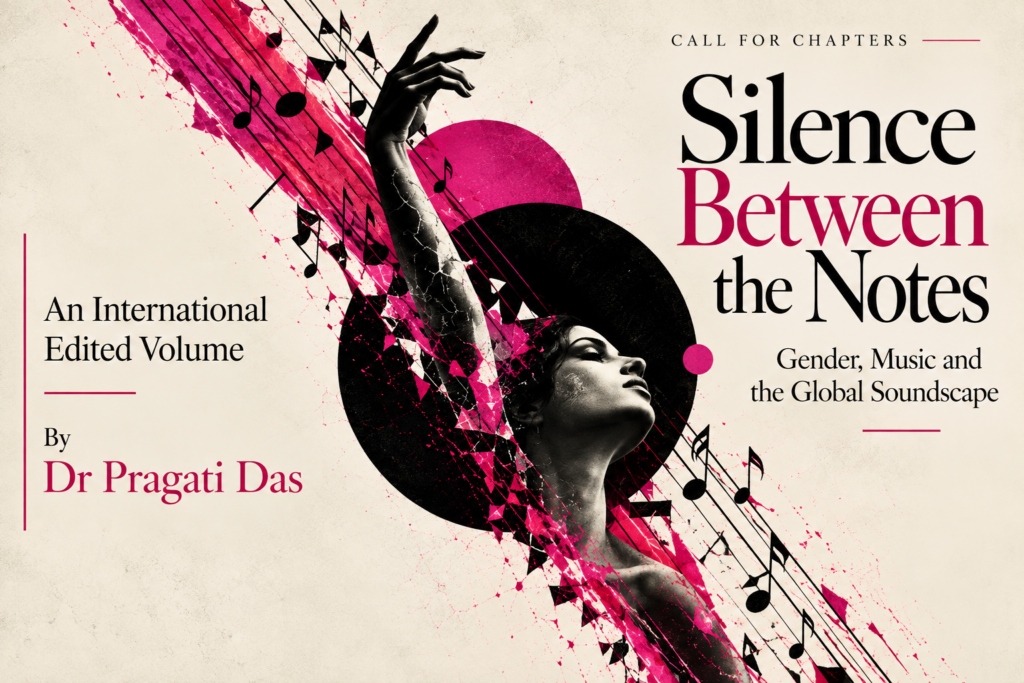
An International Edited Volume
By Dr Pragati Das
Faculty member in the PG and Research Department of English at Bhatter College, Dantan (Autonomous), West Bengal, India
Historically, in music, questions of who is heard, who is represented, who is authorised to speak, and who remains unheard have remained deeply intertwined with gender. The ‘silence’ between the notes, therefore, is the cultural, institutional, and historical spaces in which voices have been marginalised or rendered inaudible. At the same time, silence can become an active space of resistance and alternative voices. In view of these issues, the volume invites theoretically grounded interdisciplinary approaches to music. Feminist musicology offers insights into how musical forms, histories, institutions, and canonical traditions help construct gendered meanings. Susan McClary’s Feminine Endings (1991) opened influential possibilities for reading musical structures and conventions in relation to gender and sexuality. Marcia Citron’s Gender and the Musical Canon (2000) has drawn attention to the historical processes through which women composers and their works have been excluded from established musical canons. These perspectives raise questions about authorship, creativity, musical authority, canon formation and the culturally constructed figure of the musical “genius.”
The volume considers voice and embodiment in relation to the politics of performance. Applying Judith Butler’s theory of gender performativity (Gender Trouble, 1990) to musical contexts shows how vocal timbre, bodily movement, stage presence, performance conventions, and modes of listening can produce gendered identities. Chloë Alaghband-Zadeh’s concept of sonic performativity, developed through her study of North Indian classical vocal music (2015), can be utilised to show how gender may be articulated through vocal practice and culturally recognisable sonic conventions.
Questions of representation and Othering form another important dimension of the volume. Lyrics, music videos, album covers, performance cultures and popular musical narratives construct women and gender minorities as objects or cultural Others. The central questions, therefore, are: who speaks, who is spoken about, whose desire is represented, and who is granted autonomous subjectivity? Laura Mulvey’s concept of the male gaze (1975) and bell hooks’s critique of racialised and gendered representation (Black Looks, 1992) explain the visual construction of the musical body. Edward Said’s Orientalism (1978) and Gayatri Chakravorty Spivak’s writings on subalternity and representation (1988) further open possibilities for examining the interconnectedness of gender, colonial power, cultural difference and the politics of voice.
The volume also encourages intersectional and queer perspectives that resist treating gender as an isolated category. Kimberlé Crenshaw’s theory of intersectionality (1989) is particularly significant for Indian and South Asian musical cultures, where questions of musical respectability, access and authority have been determined by complex social hierarchies. Studies may therefore explore Dalit, Adivasi, minority, working-class, diasporic and queer musical practices alongside more established traditions. R. W. Connell’s theory of masculinities (2005) also enables investigations into the relationship between musical genres, masculine authority, aggression, technological expertise and professional status.
A further concern is the relationship between music, colonial modernity, memory and cultural erasure. Colonial and nationalist formations have contributed to changing binaries of respectable and disreputable performance, classical and popular music, tradition and modernity, and masculine and feminine musical authority. Amanda J. Weidman’s Singing the Classical, Voicing the Modern (2006), for example, shows the importance of examining voice and musical practice within the postcolonial politics of South Indian music. Such approaches can illuminate the histories of the tawa’ifs and devadasi traditions, folk musicians, female performers and other communities whose musical practices have been negotiated through changing structures of morality, caste, respectability and nationalism. Similarly, the absence of women and marginalised musicians from established musical histories may itself be read as an archival silence. Derrida’s insight in Archive Fever (1995) can be used to consider how archives, institutions, and systems of preservation determine what is remembered, catalogued, and canonised and what becomes inaudible.
The volume further recognises that music is embedded within material and institutional structures of labour and technology. Recording studios, educational institutions, publishing industries, festivals, media organisations, streaming platforms and professional networks all participate in determining whose music is produced, circulated and heard. Simon Frith’s Performing Rites (1996) and Lucy Green’s Music, Gender, Education (1997) offer important perspectives on music as a social and cultural practice determined by value, participation and education. These approaches open questions about gendered labour, access to technology, professional networks, production, remuneration and institutional authority.
Finally, Silence Between the Notes looks towards the digital and technological future of gendered sound. Digital production, streaming cultures, algorithmic recommendation, virtual performers, synthetic voices and artificial intelligence are transforming the relationship between the body, voice, technology and musical authorship. Donna Haraway’s cyborg theory (1991), N. Katherine Hayles’s work on virtual embodiment (1999), Rosi Braidotti’s posthumanism (2013) and Karen Barad’s theory of material-discursive entanglement (2007) provide necessary tools for examining these transformations.
This volume therefore brings together interdisciplinary perspectives and seeks to explore the silences, voices, bodies, technologies and power structures that produce the global soundscape. The suggested topics below are indicative rather than exhaustive, and contributors are welcome to propose theoretically rigorous chapters that extend the conceptual and geographical scope of the volume.
Suggested topics:
- Feminist musicology: gender, harmony, rhythm, tonality and musical narrative
- Sonic performativity: voice, timbre, pitch and the cultural construction of gender
- Women as the musical “Other”: desire, objectification and gendered address in popular lyrics
- Female agency, desire and self-representation in songwriting
- Gender, authorship and the politics of musical creativity
- The female composer and the burden of “genius”
- Archival absence, forgotten performers and the making of musical history
- Gender codes and masculine identities across musical genres
- Rock music, electric technology and the construction of masculine musical authority
- The female body on screen: sexualisation, spectatorship and agency in music videos
- The voice as a gendered body: embodiment, vocal identity and performance
- Women producers, engineers and the gender politics of studio culture
- Gender, precarity, professional networks and creative labour
- Tawa’ifs and Devadasi musical traditions: female performers between courtesan culture and modernity
- Gender, caste, sexuality and the reorganisation of performance under colonial modernity
- Dalit women’s songs as counter-memory: oral tradition, caste experience and alternative histories
- Adivasi women’s musical practices: cultural memory, land and community
- Gendered vocality in Hindustani and Carnatic traditions: voice, authority and embodied performance
- The guru–shishya tradition: gender, intimacy and authority
- Bollywood playback singing: female voice, embodiment and the separation of singer and screen body
- Women in Indian hip-hop: voice, language, class, caste and the politics of visibility
- Singing against power: feminist protest songs and political dissent
- Queering the soundscape: non-normative voices, gender identities and alternative musical cultures
- Migrant voices and diasporic soundscapes: gender, belonging, displacement and cultural memory
- Algorithms, streaming platforms and the discoverability of women musicians
- Platform economies and women’s musical careers: visibility, precarity and self-branding
- The synthetic voice: gender, embodiment and authenticity in AI-generated music
- Digital archives, alternative music histories and new forms of access
Author Guidelines
- Publishing Policies: https://rupkatha.com/books/publishing-policies/
- Publication Fees: https://rupkatha.com/books/fees/
- Plagiarism Policy: https://rupkatha.com/books/publishing-policies/9-plagiarism-policy/ (Turnitin, Grammarly, Copyleaks)
Indexing Possibilities: Indexing possibility in Scopus/WoS is subject to overall book quality and external jury decision.
Timeline
Abstract Submission: October 31 2026
Notification of Acceptance: November 15 2026
Full Chapter Submission (5000-7000 words): December 31 2026
Expected Publication: February 2027.
How to submit
Please send the following as a single Word document:
- Proposed chapter title
- Abstract (300–500 words)
- 3–5 keywords
- Author name and institutional affiliation
- Email address and Phone/WhatsApp number
- Short biographical note (80–100 words)
Stylesheet: APA
Email: pragatidaspogo@gmail.com
Subject line: Silence Between the Notes — Chapter Proposal. [Use the same email thread for all further communications]
Editor

Dr Pragati Das is a faculty member in the PG and Research Department of English at Bhatter College, Dantan (Autonomous), West Bengal, India. She holds a PhD on Leonard Cohen, with her doctoral research examining gender dynamics and the representation of women as the “Other” in Cohen’s lyric poetry. Her research interests include gender studies, music and popular culture, feminist literary studies, representation, and interdisciplinary approaches to literature and music. She is also a founder of the Critical Gender Studies Journal.