
DISCOVER THE FUTURE OF ACADEMIC PUBLISHING
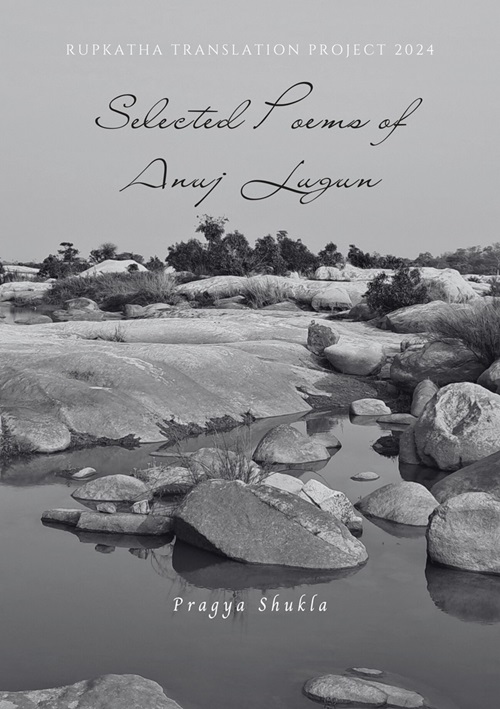
RUPKATHA BOOKSSelected Poems of Anuj Lugun
Bibliographic Details
- Publisher: Rupkatha Books (Imprint), Aesthetix Media Services (OPC) Private Limited; First edition (2024), under Rupkatha Translation Project 2024
- Language: English
- Ebook: 46 pages
- ISBN-13: 978-81-975130-7-7
- DOI: https://doi.org/10.21659/rtp01
- PDF Link: Free Access
- License: CCNC
- Dimensions: 17.6 cm x 25 cm
- Country of Origin: India
About the Book
Dr Pragya Shukla has undertaken a very complex task of translating twenty-four poems written in Hindi by Anuj Lugun about “a civilization of water, forest, and land.” The civilization that Dr Lugun speaks about has been created over a vast space of the Chhotanagpur plateau region of Chhattisgarh, Odisha, Jharkhand and the western part of West Bengal. The region itself emerged out of cosmic events in the early years of the Earth. This big geological drama can still be perceived in the open theatre of nature—rugged hills, tables, swift rivers and waterfalls, red soil, unique flora and fauna. In this primordial landscape, another drama unfolds with humans occupying their place since time immemorial. The past of the ‘civilization’ can still be perceived in the rock paintings, megaliths, and cupules scattered throughout the region. At the same time, the present tries to keep up the traditions adoringly in the face of death, destruction and development.
In these regions blessed with abundant natural resources, the tale of exploitation began with the enforcement of the Brahminical ideology of segregation and marginalization. This exploitation evolved into a systematic dehumanization and criminalization during the era of British colonialism. Today, this troubling legacy persists as development models implemented post-Independence have continued to perpetuate exploitation and inequality in these lands. Interestingly, Pathalgadhi, the original Hindi poetry book, bears a symbolically significant cover by presenting a megalith with inscriptions. The megaliths of the region are originally silent with no inscriptions. Inscribing the stone artistically on the cover turns out to be a conscious act of reclaiming history.
The struggle never entered the historical record, resulting in prolonged trauma for the Adivasis of the region. These suppressed histories were assimilated in various cultural acts of resistance, like the performing arts. Oral and visual in communication, the arts have gone to the collective cultural memory of the Adivasis. Dr Anuj Lugun has drawn on these traditions; with this, his poetry has become polyphonic and multi-layered. Many voices—ancestors, male and female, nature, flora and fauna- speak through his art. The poet collects his materials from deep memory, transmitted orally and kinetically. When he puts them into poetic expressions, they turn into profound poetic messages. In some places, Lugun seems to enter a shamanic trance, uttering words of wisdom unknown to others.
Perhaps because of the profound nature of the messages, the translator felt like “partaking in a sacred act” while translating the poems. Philosophers from Plato to Coleridge talked about the shaping power of imagination, transforming an experience into an understanding. Lugun’s poetry follows the same line of the creative process in transforming into filtered expressions of “human experiences: from the strength of the resilient, the vulnerability of the marginalized, the laughter of the lively, to the despair of the victims.” Lugun’s art also seems to have been influenced by the rhythm of the Adivasi music with all its simplicity, brevity and starkness—sometimes lively and sometimes sombre.
About the Translator
Dr Pragya Shukla is an Assistant Professor in the Department of English Studies at the Central University of Jharkhand. Her areas of interest include Gender Studies and Tribal Literature. Her doctoral thesis focused on “A Comparative Study of the Fictional Works of Githa Hariharan and Shashi Deshpande.” In addition to research papers, she is also involved in translation and writing poetry and short stories. Email: pragya.shukla@cuj.ac.in
Get In Touch
Rupkatha Books, a leading academic publisher, invites you to submit your book proposal for open access publication. We are dedicated to advancing scholarship by releasing high-quality books that are meticulously curated and freely accessible to ensure knowledge is shared without barriers. Our Book Processing Charges (BPC) depend on the nature of the books and are negotiable. The chapter Processing Charge (CPC) for a 5,000-word chapter is set at 100 USD.