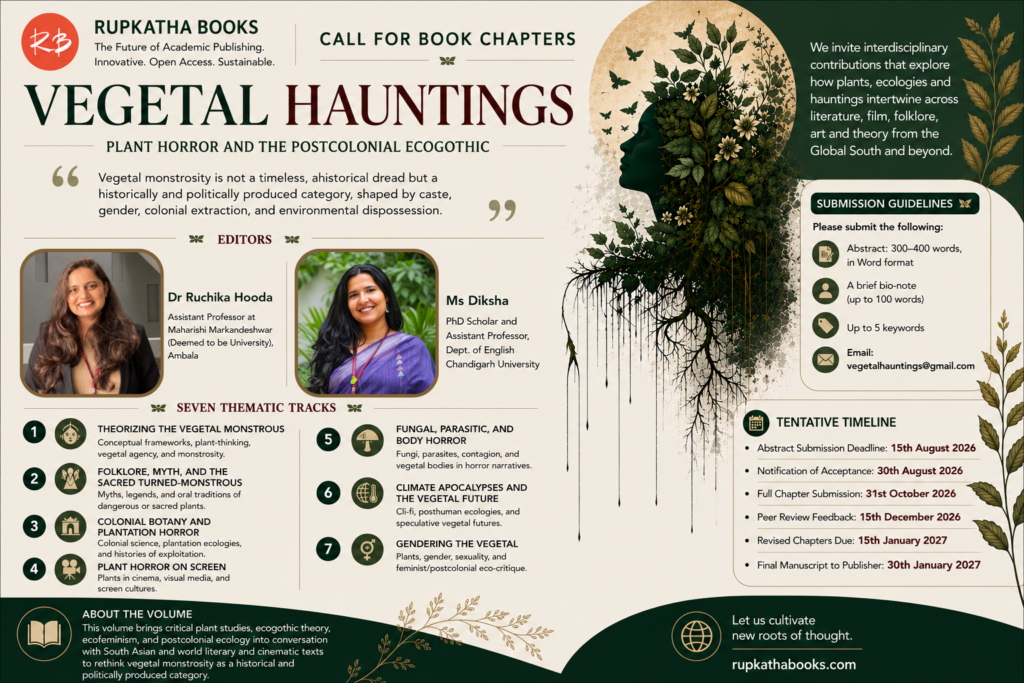
An Edited Volume by
Ruchika Hooda
Assistant Professor at Maharishi Markandeshwar (Deemed to be University), Ambala
Ms. Diksha
Assistant Professor in the Dept. of English at Chandigarh University, Chandigarh
Concept Note
Michael Marder’s foundational claim in Plant-Thinking (2013) is that vegetal life poses a distinct philosophical problem precisely because it resists every category Western thought has used to grant beings significance. Plants have no discernible interiority, no centralised nervous system, and no intentional relation to the world as animals and humans are assumed to have, and this absence has allowed philosophy to treat plant existence as beneath serious inquiry rather than as an unresolved question in its own right. Plant horror, defined as the enduring cultural fascination with predatory vines, sentient forests, carnivorous gardens, and monstrous bloom, has emerged as a recognisable strand of the ecogothic, yet existing scholarship remains overwhelmingly Euro-American in scope and theoretical orientation. The South Asian, postcolonial, and Global South vegetal imagination remains critically underexplored. This book volume proposes to address this gap by bringing critical plant studies, ecogothic theory, ecofeminism, and postcolonial ecology into sustained conversation with South Asian and world literary and cinematic texts.
The most significant scholarly intervention in the field to date, Dawn Keetley and Angela Tenga’s Plant Horror (2016), mapped the recurring tropes of the genre largely across British and American texts. However, it left the postcolonial vegetal imagination almost entirely unexamined. South Asia offers an exceptionally rich archive for this inquiry. Long before plant horror was named as a genre, regional folk traditions had already populated forests and groves with vegetal beings that blur the line between sacred guardian and predatory threat. The yakshi of Kerala’s tree-spirit lore offers the most instructive example of this trajectory: in early Dravidian and Vedic traditions, yakshis were revered as benevolent nature deities, symbolising fertility, beauty, and the protective spirit of the sacred grove or Kavu. Only under the pressures of later patriarchal and Brahmanical religious shifts was their image inverted, from guardian to predator, from deity to vampiric ghost.
Art historians of early Indian religion have long traced this trajectory in the yaksha/yakshi figures themselves. Ananda Coomaraswamy’s foundational study identified these tree-spirits as pre-Vedic, animist deities of fertility and abundance, later incorporated into Brahmanical cosmology. Stella Kramrisch similarly located their origin in indigenous nature-worship that predates and exceeds the subordinate place later religious orthodoxy would assign them. The formative history of colonial botany was imposed upon this, with the result that the plantation, the botanical garden, and the cash crop contributed to the making of horror architectures. Colonial forced plantations of indigo, tea, rubber, and opium uprooted both ecosystems and communities, and that violence resurfaces in literature and cinema, displaced onto Gothic plant imagery. The argument this volume insists on is that vegetal monstrosity is not a timeless, ahistorical dread but a historically and politically produced category, shaped by caste, gender, colonial extraction, and environmental dispossession.
A recurring thread throughout the volume is the persistent gendering of the monstrous plant. Across folklore, fiction, and film, the dangerous plant-being is disproportionately coded as female, seductive, fertile, devouring, and ultimately punished or exorcised at the end of the narrative. Reading the demonisation of these figures as historically produced, configured by caste, gender, and religion rather than arising organically from an ‘ancient’ fear of nature, is itself a theoretical move the volume insists on.
The volume also attempts to situate plant horror as a contemporary mode of climate feeling. As anthropogenic climate change destabilises the boundary between cultivated and wild, plant horror narratives offer one of the few popular vocabularies available for processing the unsettling sense that the vegetal world might no longer remain passive.
The volume invites contributions that explore questions such as
- How do South Asian and postcolonial traditions of plant-being such as folklore, sacred grove ecology, and animist cosmology shape regional inflexions of vegetal horror distinct from those theorised by Western ecocriticism?
- How does the history of colonial botany, the plantation, the botanical garden, the cash crop, function as a horror architecture, encoding environmental and political violence in vegetal Gothic imagery?
- How is the monstrous plant persistently gendered, and what does this reveal about the co-implication of patriarchal and ecological domination?
- What new forms of vegetal horror are emerging in response to climate anxiety, pandemic contagion, and posthuman ecological futures?
- How do literary and cinematic plant horror texts in South Asian languages construct, contest, or revise the genre’s conventions?
- How can indigenous and folk epistemologies of plant agency serve as theoretical resources, rather than mere objects of study, for plant horror scholarship?
- How can critical plant studies be brought into productive dialogue with horror theory to theorize vegetal monstrosity beyond anthropocentric frameworks?
Thematic Tracks
The volume is organized into seven thematic tracks. Contributors are invited to identify the track most relevant to their submission, though cross-track work is encouraged where the material demands it.
- Track 1: Theorising the Vegetal Monstrous
Horror theory has largely been built around creatures that hunt, intend, and violate, categories that sit uneasily with organisms that have no brain and operate on timescales humans can barely perceive. Chapters may ask whether a plant can be truly monstrous without a mind, drawing on Marder, Gagliano, or Hall as theoretical foundations.
- Track 2: Folklore, Myth, and the Sacred-Turned-Monstrous
This track examines oral and religious traditions that coded plants as dangerous long before horror emerged as a genre, centred on Kerala’s yakshi and related Tamil, Sri Lankan, and North Indian tree-spirit figures. Their demonisation must be read as historically produced, shaped by caste, gender, and religion, rather than as natural or inevitable.
- Track 3: Colonial Botany and Plantation Horror
This track treats the empire’s relationship to plants as the historical engine of vegetal horror, with colonial monoculture uprooting ecosystems and communities, and that violence resurfacing as overgrown plantations and retaliating crops. Indigo-plantation literature and tea-garden fiction from Assam and Bengal offer natural source material.
- Track 4: Plant Horror on Screen
This track turns to film studies, examining how forests, roots, and vines generate dread through cinematography and sound design rather than narration alone. South Asian horror cinema, including Tumbbad, Bulbbul, and Malayalam and Tamil Yakshi films, offers rich, under-theorised material.
- Track 5: Fungal, Parasitic, and Body Horror
The volume’s most contemporary track connects plant horror to post-pandemic infection narratives, covering mycelial and fungal horror, spore-spread, and human-plant hybridity. Contributors may draw on posthumanism and new materialism to treat the porous boundary between human and vegetal bodies.
- Track 6: Climate Apocalypse and the Vegetal Future
This track covers speculative fiction where vegetal overgrowth or plant rebellion functions as climate allegory, drawing on Albrecht’s solastalgia and Nixon’s slow violence. It welcomes both dystopian readings of nature’s revenge and more hopeful, restorative posthuman futures.
- Track 7: Gendering the Vegetal
A cross-cutting ecofeminist track theorising the persistent coding of dangerous plant figures as female, from the yakshi to the devouring garden, drawing on Plumwood and Warren’s linking of woman and nature as twin categories of otherness. It may stand alone or cross-cut Tracks 2 and 4.
Submission Guidelines
Please submit the following:
- Abstract: 300-400 words, in Word format
- A brief bio-note (up to 100 words)
- Up to 5 keywords
- Email: editors.vegetalhauntings@gmail.com
Selected contributors will be invited to submit full-length chapters of approximately 5,000–7,000 words, including references. Chapters should follow APA style. Submissions must be in MS Word (.docx) format. All chapters will be subjected to plagiarism and AI detection through Turnitin, Grammarly and Copyleaks. Once the reports are satisfactory, chapters undergo double-blind peer review.
Author Guidelines
- Publishing Policies: https://rupkatha.com/books/publishing-policies/
- Publication Fees: https://rupkatha.com/books/fees/
- Plagiarism Policy: https://rupkatha.com/books/publishing-policies/9-plagiarism-policy/ (Turnitin, Grammarly, Copyleaks)
Indexing Possibilities: Indexing possibility in Scopus/WoS is subject to overall book quality and external jury decision.
Tentative Timeline
- Abstract Submission Deadline: 15th August 2026
- Notification of Acceptance: 30th August 2026
- Full Chapter Submission: 31st October 2026
- Peer Review Feedback: 15th December 2026
- Revised Chapters Due: 15th January 2027
- Final Manuscript to Publisher: 30th January 2027
Submission and Queries
- Please send abstracts and inquiries to: editors.vegetalhauntings@gmail.com
- Please use the subject line: ‘Vegetal Hauntings – Abstract Submission – [Your Name]’
- Queries about scope, track fit, or submission procedures are welcome before the abstract
Why Publish with Rupkatha Books?
Rupkatha Books is an international open-access academic publisher committed to disseminating high-quality scholarship across the humanities and social sciences. Authors benefit from:
- International affiliations
- Rigorous double-anonymous peer review and international editorial standards
- Open-access dissemination, global discoverability and scholarly visibility
- DOI assignment for individual chapters, Crossref registration with metadata
- Copyrights kept by authors.
- Worldwide readership across academic communities
Volume Editors
Ruchika Hooda is an Assistant Professor at Maharishi Markandeshwar (Deemed to be University), Ambala. She holds a PhD (2023) and an MPhil (2020) in English from Maharshi Dayanand University. She has served as an Assistant Professor at Chandigarh University and as a Guest Skill Assistant Professor at Shri Vishwakarma Skill University. She is currently a member of the editorial board of The Criterion: An International Journal in English (ISSN: 0976-8165). She has edited the book Writing the Living World (ISBN: 978-93-81818-96-1). Her research interests include Indian English Literature, mythology, and environmental humanities, with a focus on Alternate History and Deep Ecology, emphasising eco-conscious literary inquiry.
Diksha is a PhD scholar and Assistant Professor in the Dept. of English at Chandigarh University, where she teaches undergraduate and postgraduate courses in communication. Her scholarly work operates at the confluence of posthumanism, ecocriticism, trauma theory, and feminist theory, with sustained attention to contemporary fiction. With over 4.5 years of teaching experience, she is committed to intellectual rigour and pedagogical vitality and cultivates in her students a capacity for critical inquiry and meaningful engagement with literature, language, and the wider world.