2013 - Page 5

A Feminist Aesthetics of Nature

1.3K views

Tegan Zimmerman, University of Alberta, Edmonton, Alberta, Canada

 Download PDF Version

Abstract

This article examines the relatively unstudied field of the aesthetics of nature from a feminist perspective. Currently a feminist aesthetics of nature does not exist in scholarship, though I argue in our age of eco-crisis this is necessary. I explore what this feminist approach might entail by discussing three essential elements to the current masculinist study of nature: 1) the role of the subject or observer, 2) method of appreciation, and 3) appropriate object for appreciation. By focusing on the recent impasse in feminism, between essentialism and non-essentialism, this paper looks at how each side of the debate would approach these above three topics, and what future paths feminism might take in creating an adequate study of the aesthetics of nature.  Keep Reading

Causation as Metaphor–a Catachresis

373 views

Robert C Robinson, University of Georgia, USA

 Download PDF Version

Abstract

The thesis of this paper is that causation, when described and treated as a metaphor, increases in explanatory power, while diminishing the problems associated with standard analysis of it. I  first present a description of the uses of metaphor in scientific and literary language. This is drawn primarily from Max Black’s interaction view of metaphor, as well as the view forwarded by Donald Davidson in his What Metaphors Mean. I then outline some of the standard analyses in the field of causation, followed by some of the standard replies to those analyses. Finally, I show how describing causation in terms of a metaphor will bypass many of these objections, while maintaining or increasing its explanatory power. Keep Reading

In Search of… a Third Culture: Towards an Experimental Science and Nature Cinema

274 views

 Walter C. Metz, Southern Illinois University

 Download PDF Version

Abstract

This essay attempts to move beyond C.P. Snow’s reductive formulation of the two cultures, positing a third culture forged out of the collision of science documentary television with the avant-garde traditions of the cinema. In particular, I use both scientific and humanistic understandings of memory to compare and contrast a science television program, “Understanding the Mysteries of Memory” (Science Channel, 2002) with an avant-garde film, Report (Bruce Conner, 1967). Keep Reading

Carbon Footprint –A Model Structure for our Future

347 views

Michael Dan Archer, School of Art and Design, Loughborough University

For images please download PDF Version

 Introduction

Michael Dan Archer, British Sculptor and Senior Lecturer in Fine Art at Loughborough University School of the Arts in the UK is currently working on a project with Ray Leslie, Professor of Chemistry at Nottingham University, James Davis, Nottingham Trent University, Simon Austin, Professor of Structural Engineering at Loughborough University, Tony Thorpe, Civil and Building Engineering, Loughborough University on a project to illustrate the volume of the Carbon Footprint of an average British family through a large sculptural tower partly based on the form of a carbon nanotube and partly on the shape of a power station cooling tower. Keep Reading

TechnoMetamorphosis by Rob Harle

243 views

About the Artist 

Rob Harle is an artist, writer and researcher. His academic work involves research into the philosophy of Transhumanism, Artificial Intelligence and the nature of Embodiment. He recently abandoned a PhD in philosophy concerned with the relationship of human consciousness with an all-integrating field of matter, to instead develop his digital art work. Keep Reading

CREATIVE: Invasive Species by Roy Frank Staab

209 views

About the Artist

Roy Frank Staab (b. 1941) attended Layton School of Art and received a BFA from UWM in 1969, extending studying in Europe, settling in Paris.  He had first exhibition in 1977.  His artworks found place in the collections of the Muséed’Art Moderne de la Ville de Paris, France, Le Fonds national d’art contemporain, Paris, France.  He began making site-installation art in 1979 in France. In 1980 he moved to New York City [works-on-paper in Metropolitan Museum of Art, New York, NY].  By 1983 he shifted to working entirely in nature, employing natural materials from each site and became a peripatetic artist making his ephemeral outdoor sculpture installations in many places throughout the world. He received grants from the New York Foundations for the Arts, New York State Council on the Arts, U.S./Japan Creative Artists’ Fellowship, Artist-in-Museum Yokohama Museum of Art, Joan Mitchell Foundation award.  He has installed works in Brazil, Canada, Costa Rica, Finland, France, Italy, Japan, Korea, Taiwan, and the United States.

Artist’s Statement

I learned to question and opened the door to experiment and experience, finding the freedom to make art ‘my way’ and choose or reject traditional techniques as a means—to create visual experiences that excite me. It took ten years for my art to evolve from painting, to line structure on paper, to installation. I started to make works in/over water—large works, my drawings in space, using only natural materials gathered from near by. I like the idea of working with nature, geometry and physical science to make works that can be considered a meditation on perception and being—with the idea of ephemeral, nothing to hold on to but the visual experience; Art that is and transcends the object. I make art in nature and refer and depend upon nature and natural sciences to work with me on the art.

Artworks

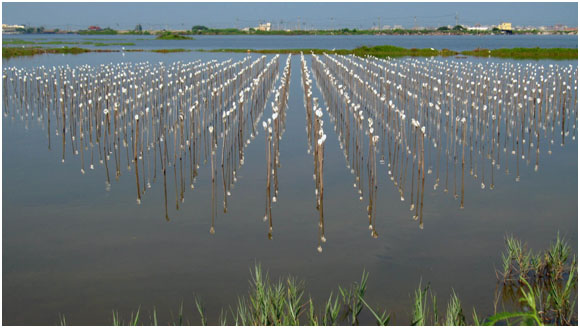
Invasive Species*
Invasive Species*

 [*because of the fish that escaped that were non-native and took over the native species there in Chen-Long, Taiwan]

There is the oyster fishing industry where they grow oysters and then they reuse some of the shell to grow a new stock. I found piles of discarded shells.  I came up with the idea of putting them on bamboo, held in place by the tension of a slit.  But I learned later, that was the old way they used to grow oysters there. The work is designed to be a long free form like an abstract fish [that I told the children] to fit the land area. I use the oyster shells all facing the sunrise to give the very white glow at that special time.  I was told of the high water rainy season and made the work to be magic.  The rain did not come in May as predicted, but in the end of July, making my art complete with reflection and isolation in the water.

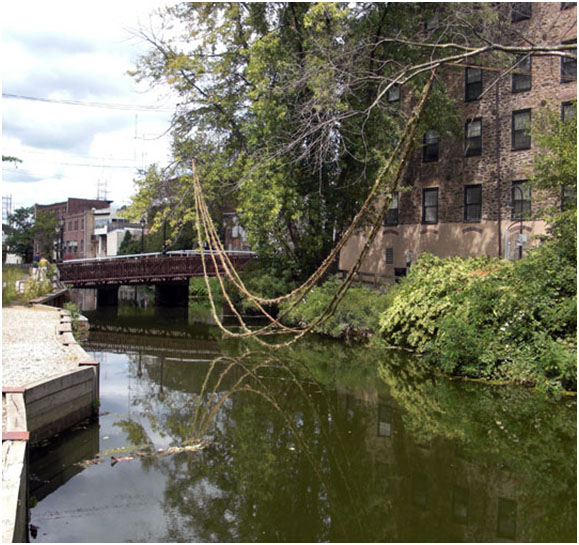
Suspended between the living and the dead

In Philadelphia—I use the cantenary curve (gravity) and wind for my art to move and swing. The situation is to make a work over the canal in a visible place accessible to people to. I chose a place where trees suspend over the canal. But one tree, an elm, was dead, hence the title ‘Suspended between the living and the dead’. I had to test the branch of the dead tree and make sure it will hold. I put up a measuring line between the trees and then took it down and extended it out along the canal edge. The materials for the lines are collected from the nearby abandoned lands. I did not want the line to stretch out as it did on another work, so I use the Japanese knotweed as the main support and tooth-picked it end to end and then layered the line with other weeds such as goldenrod, mug wart and bundle it using jute cord. Sometimes the wind in the tops of the trees makes the work bounce, other times it moves and sways by the wind in the work.  It is held out by bamboo and balanced by stones where needed.

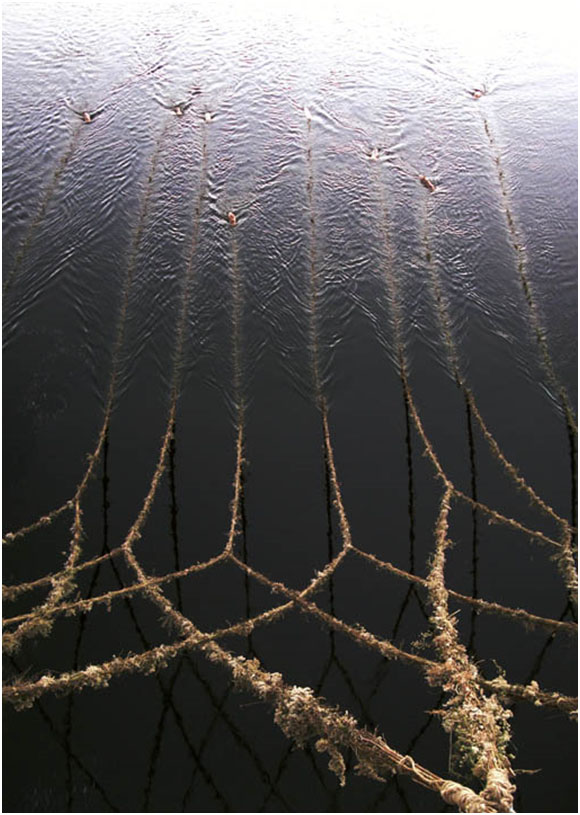
Eau Claire Currents
Eau Claire Currents

For the work Eau Claire Currents, made for the University of Wisconsin Eau Claire, a suggested idea as to make a work on the sandbar in the river below the walking bridge.  But the two times that I came to see the site, the Chippewa River was in flood because of the heavy rains. I responded to the site, the bridge and my concern that the people walking over the bridge could see something, not just hang down hanging down, but pulled out by the current. I use the bridge railing supports for the placement of the work and the measure between the lines, for the right shape and proportions of the lines. I am concerned with it lasting as long as possible so the junctions had to be above the water, as I know that the natural materials breakdown in a short time in the water and current.  Ephemeral art belongs in nature and I have no problem with that. The ‘Y’ shaped tendrils were made with wild weeds and bundled with jute. I chose to punctuate the ends in the water using torpedo shaped logs. To my surprise when they were tied on, instead of just staying in a straight line of the current [they were not streamlined enough], they move back and forth giving movement to the work that I like. Slowly, piece-by-piece, parts break off and slipped silently down the river. The work is made with all organic materials and will rot as other river detritus does over time.

More info about Roy Staab and his art can be found at http://roystaab.blogspot.com

Mensuration of a Kiss: The Drawings of Jorinde Voigt

316 views

Julia Thiemann

Download PDF Version

Biography

Jorinde Voigt, born 1977 in Frankfurt am Main in Germany, studied Visual Cultures Studies first in the class of Prof. Christiane Moebus and then at Prof. Katharina Sieverding at the University of Arts in Berlin. Voigt completed her studies 2004 as Meisterschülerin of Prof. Sieverding. Since 2002 Jorinde Voigt has numerous solo exhibitions and group shows for example in Germany, The Netherlands, Italy, Sweden and The United States of America. Her work is represented in various collections, such as the Museum of Prints and Drawings Berlin or the Federal Republic of Germany’s Contemporary Art Collection. She lives and works in Berlin, Germany. Keep Reading

BOOK RECEIVED AND REVIEWED Interdisciplinarity (2nd Edition) by Joe Moran

362 views

Routledge

12th February 2010

Paperback, 214 pages

Price: £12.99

ISBN: 978-0-203-86618-4

Series: The New Critical Idiom

Review Article by

Martin Paul Eve

University of Sussex, UK Keep Reading

Book Received and Reviewed: Chouboli and Other Stories (Vols. I & II)

581 views

Vijaydan Detha

Translated by Christi a Merrill with Kailash Kabir

 Download PDF Version

Publisher: Katha, in collaboration with Fordham University  Press, New York 2010, New Delhi ISBN 978-81-89934-42-2Pages 184 Price:  ` 1500.00

Review by Tarun Tapas Mukherjee

Bhatter College, Paschim Medinipur, India Keep Reading

Charles Dickens’s A Child’s History of England and Spain

1K views

José Ruiz Mas, University of Granada, Spain

 Download PDF Version

Abstract

In this article I endeavour to analyse the image of relevant Spanish historical figures such as King Pedro I, Catherine of Aragon, Christopher Columbus, Philip II, the Spanish Armada and other pro-Spanish English characters such as Mary I, as depicted in Charles Dickens’ A Child’s History of England (1851-53). In his overtly didactic attempt to convey a specific image of the legendary antagonism existing between Spain and England to his contemporary English children and youngsters through this peculiar history book, Dickens amply shows his prejudiced view of Spanish history and his overtly patriotic description of England’s history. Proof of the relevance and the persistence of Dickens’ anti-Spanish and anti-Catholic attitude that prevailed in English society throughout the second half of the 19th century is that C. R. L. Fletcher and Rudyard Kipling insist on similar ideas of Anglo-Spanish relations in A School History of England (1911). Keep Reading

1 3 4 5 6 7 17