by Editor | Sep 28, 2026 | Book Chapter, Call for Book Chapters, Edited Volume, Gender and Music
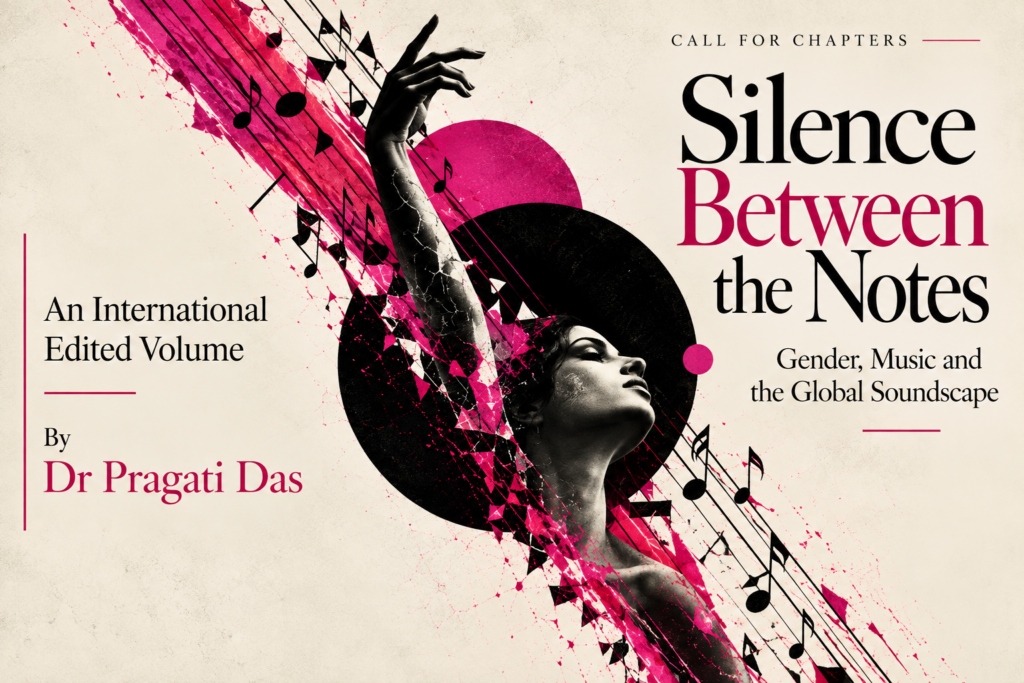
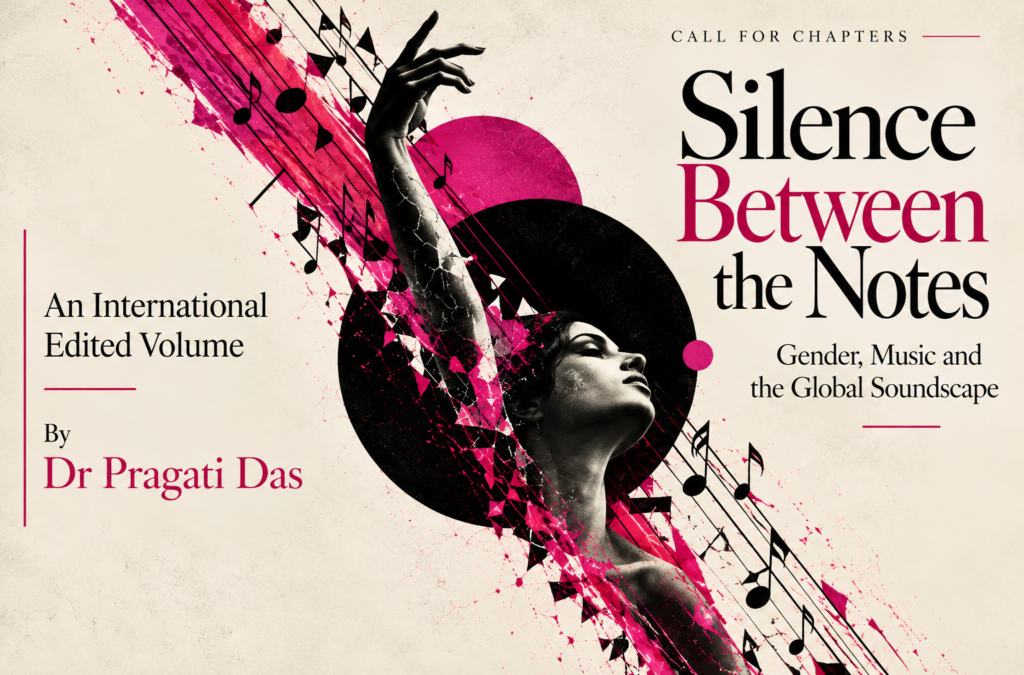
An International Edited Volume
By Dr Pragati Das
Faculty member in the PG and Research Department of English at Bhatter College, Dantan (Autonomous), West Bengal, India
Historically, in music, questions of who is heard, who is represented, who is authorised to speak, and who remains unheard have remained deeply intertwined with gender. The ‘silence’ between the notes, therefore, is the cultural, institutional, and historical spaces in which voices have been marginalised or rendered inaudible. At the same time, silence can become an active space of resistance and alternative voices. In view of these issues, the volume invites theoretically grounded interdisciplinary approaches to music. Feminist musicology offers insights into how musical forms, histories, institutions, and canonical traditions help construct gendered meanings. Susan McClary’s Feminine Endings (1991) opened influential possibilities for reading musical structures and conventions in relation to gender and sexuality. Marcia Citron’s Gender and the Musical Canon (2000) has drawn attention to the historical processes through which women composers and their works have been excluded from established musical canons. These perspectives raise questions about authorship, creativity, musical authority, canon formation and the culturally constructed figure of the musical “genius.”
The volume considers voice and embodiment in relation to the politics of performance. Applying Judith Butler’s theory of gender performativity (Gender Trouble, 1990) to musical contexts shows how vocal timbre, bodily movement, stage presence, performance conventions, and modes of listening can produce gendered identities. Chloë Alaghband-Zadeh’s concept of sonic performativity, developed through her study of North Indian classical vocal music (2015), can be utilised to show how gender may be articulated through vocal practice and culturally recognisable sonic conventions.
Questions of representation and Othering form another important dimension of the volume. Lyrics, music videos, album covers, performance cultures and popular musical narratives construct women and gender minorities as objects or cultural Others. The central questions, therefore, are: who speaks, who is spoken about, whose desire is represented, and who is granted autonomous subjectivity? Laura Mulvey’s concept of the male gaze (1975) and bell hooks’s critique of racialised and gendered representation (Black Looks, 1992) explain the visual construction of the musical body. Edward Said’s Orientalism (1978) and Gayatri Chakravorty Spivak’s writings on subalternity and representation (1988) further open possibilities for examining the interconnectedness of gender, colonial power, cultural difference and the politics of voice.
The volume also encourages intersectional and queer perspectives that resist treating gender as an isolated category. Kimberlé Crenshaw’s theory of intersectionality (1989) is particularly significant for Indian and South Asian musical cultures, where questions of musical respectability, access and authority have been determined by complex social hierarchies. Studies may therefore explore Dalit, Adivasi, minority, working-class, diasporic and queer musical practices alongside more established traditions. R. W. Connell’s theory of masculinities (2005) also enables investigations into the relationship between musical genres, masculine authority, aggression, technological expertise and professional status.
A further concern is the relationship between music, colonial modernity, memory and cultural erasure. Colonial and nationalist formations have contributed to changing binaries of respectable and disreputable performance, classical and popular music, tradition and modernity, and masculine and feminine musical authority. Amanda J. Weidman’s Singing the Classical, Voicing the Modern (2006), for example, shows the importance of examining voice and musical practice within the postcolonial politics of South Indian music. Such approaches can illuminate the histories of the tawa’ifs and devadasi traditions, folk musicians, female performers and other communities whose musical practices have been negotiated through changing structures of morality, caste, respectability and nationalism. Similarly, the absence of women and marginalised musicians from established musical histories may itself be read as an archival silence. Derrida’s insight in Archive Fever (1995) can be used to consider how archives, institutions, and systems of preservation determine what is remembered, catalogued, and canonised and what becomes inaudible.
The volume further recognises that music is embedded within material and institutional structures of labour and technology. Recording studios, educational institutions, publishing industries, festivals, media organisations, streaming platforms and professional networks all participate in determining whose music is produced, circulated and heard. Simon Frith’s Performing Rites (1996) and Lucy Green’s Music, Gender, Education (1997) offer important perspectives on music as a social and cultural practice determined by value, participation and education. These approaches open questions about gendered labour, access to technology, professional networks, production, remuneration and institutional authority.
Finally, Silence Between the Notes looks towards the digital and technological future of gendered sound. Digital production, streaming cultures, algorithmic recommendation, virtual performers, synthetic voices and artificial intelligence are transforming the relationship between the body, voice, technology and musical authorship. Donna Haraway’s cyborg theory (1991), N. Katherine Hayles’s work on virtual embodiment (1999), Rosi Braidotti’s posthumanism (2013) and Karen Barad’s theory of material-discursive entanglement (2007) provide necessary tools for examining these transformations.
This volume therefore brings together interdisciplinary perspectives and seeks to explore the silences, voices, bodies, technologies and power structures that produce the global soundscape. The suggested topics below are indicative rather than exhaustive, and contributors are welcome to propose theoretically rigorous chapters that extend the conceptual and geographical scope of the volume.
Suggested topics:
- Feminist musicology: gender, harmony, rhythm, tonality and musical narrative
- Sonic performativity: voice, timbre, pitch and the cultural construction of gender
- Women as the musical “Other”: desire, objectification and gendered address in popular lyrics
- Female agency, desire and self-representation in songwriting
- Gender, authorship and the politics of musical creativity
- The female composer and the burden of “genius”
- Archival absence, forgotten performers and the making of musical history
- Gender codes and masculine identities across musical genres
- Rock music, electric technology and the construction of masculine musical authority
- The female body on screen: sexualisation, spectatorship and agency in music videos
- The voice as a gendered body: embodiment, vocal identity and performance
- Women producers, engineers and the gender politics of studio culture
- Gender, precarity, professional networks and creative labour
- Tawa’ifs and Devadasi musical traditions: female performers between courtesan culture and modernity
- Gender, caste, sexuality and the reorganisation of performance under colonial modernity
- Dalit women’s songs as counter-memory: oral tradition, caste experience and alternative histories
- Adivasi women’s musical practices: cultural memory, land and community
- Gendered vocality in Hindustani and Carnatic traditions: voice, authority and embodied performance
- The guru–shishya tradition: gender, intimacy and authority
- Bollywood playback singing: female voice, embodiment and the separation of singer and screen body
- Women in Indian hip-hop: voice, language, class, caste and the politics of visibility
- Singing against power: feminist protest songs and political dissent
- Queering the soundscape: non-normative voices, gender identities and alternative musical cultures
- Migrant voices and diasporic soundscapes: gender, belonging, displacement and cultural memory
- Algorithms, streaming platforms and the discoverability of women musicians
- Platform economies and women’s musical careers: visibility, precarity and self-branding
- The synthetic voice: gender, embodiment and authenticity in AI-generated music
- Digital archives, alternative music histories and new forms of access
Author Guidelines
Indexing Possibilities: Indexing possibility in Scopus/WoS is subject to overall book quality and external jury decision.
Timeline
Abstract Submission: October 31 2026
Notification of Acceptance: November 15 2026
Full Chapter Submission (5000-7000 words): December 31 2026
Expected Publication: February 2027.
How to submit
Please send the following as a single Word document:
- Proposed chapter title
- Abstract (300–500 words)
- 3–5 keywords
- Author name and institutional affiliation
- Email address and Phone/WhatsApp number
- Short biographical note (80–100 words)
Stylesheet: APA
Email: pragatidaspogo@gmail.com
Subject line: Silence Between the Notes — Chapter Proposal. [Use the same email thread for all further communications]
Editor

Dr Pragati Das is a faculty member in the PG and Research Department of English at Bhatter College, Dantan (Autonomous), West Bengal, India. She holds a PhD on Leonard Cohen, with her doctoral research examining gender dynamics and the representation of women as the “Other” in Cohen’s lyric poetry. Her research interests include gender studies, music and popular culture, feminist literary studies, representation, and interdisciplinary approaches to literature and music. She is also a founder of the Critical Gender Studies Journal.

by Editor | Jun 17, 2026 | Book Chapter, Edited Volume, Urban Imaginaries and Indian Cities in Literature
Dr. Sudakshina Bhattacharya¹ , Dr. Sulagna Mohanty² & Dr. Ankusha Bandyopadhyay³
¹ ³Assistant Professor (Sr. Gr), Department of English & Humanities, Amrita School of Arts, Humanities & Commerce, Coimbatore, Amrita Vishwa Vidyapeetham, India. *Corresponding author.
²Assistant Professor, Department of Language, Culture and Society, Faculty of Engineering & Technology, SRM Institute of Science and Technology, Kattankulathur, Chennai.
 10.21659/9788197513022.08
Abstract
The concept of spatiality in India is continually evolving with transitions in the social, cultural, political, and economic spheres, shaping our perspectives on spatiality. India is now beginning to be recognised not only as a principally rural and agrarian country but is also attracting notice for its urban spaces and urbanity, including its innate intricacies. The Indian scholarship in this direction is proliferating in commendable ways. Apart from the critical enquiries, several writers have produced brilliant literary works about Indian cities, like Khuswant Singh, Amitav Ghosh and Mamang Dai, to name only a few. However, an extensive literature review reveals that a minimal eclectic analysis is seen about the smaller urban places in India, such as Sikkim’s capital city, Gangtok. Our study stems from this huge research gap because the process of urbanisation is happening ubiquitously in India, and hence, scholarly probes cannot be limited to the comprehension of the established Indian metropolises alone. Through an interpretive analysis of Satyajit Ray’s detective fiction Trouble in Gangtok (1971) and the documentary film titled Sikkim (1971), and Prajwal Parajuly’s novel Land Where I Flee (2014), the present research attempts to understand the urban nuances of Gangtok within the broad framework of spatial studies to highlight the existence of unique Indian urbanity.
Keywords: Spatial turn, Urbanity, Gangtok, Satyajit Ray, Prajwal Parajuly.
Full-Text Chapter PDF Full Text Book PDF
Urban Imaginaries and Indian Cities in Literature
Table of Contents
Front Matter
Urban Imaginaries and Indian Cities in Literature: An Introduction
Dr. Neethu P Antony and Dr. Arpana Venu
Abstract Full Text PDF
City as Micro-Narratives of Senses and Everyday Experiences: An Analytical Study of Selected Stories from People Called Kolkata
Olivia Joseph
Abstract Full Text PDF
Multilingual Metropolis: The Politics of Language and Belonging in Guwahati Through Sheelabhadra’s Fiction
Sangeeta Bhagawati
Abstract Full Text PDF
Spatial (re)orientations and Epic structures of the urban in Fareeda Mehta’s Kali Salwaar
Elroy Pinto
Abstract Full Text PDF
Between Tramline and Traffic Jam: Mapping Indian City through Satyajit Ray’s Mahanagar and Anurag Basu’s Life in a…Metro
Trisha Sengupta & Dr. Sanghamitra Baladhikari
Abstract Full Text PDF
Reimagining Kolkata: Subaltern Narratives and the Colonial Urban Dystopia in Kallol Magazine’s Literature
Nandini Gayen
Abstract Full Text PDF
Walking, Writing and Resisting the City: Spatial Tactics and Postcolonial Reimaginings in Janice Pariat’s Everything the Light Touches
Parvin Sultana
Abstract Full Text PDF
Mimesis, Montage and Mapping: A Spatial Analysis of Gangtok City Scapes in the Select Works of Satyajit Ray and Prajwal Parajuly
Dr. Sudakshina Bhattacharya, Dr. Sulagna Mohanty, and Dr. Ankusha Bandyopadhyay
Abstract Full Text PDF
by Editor | Jun 17, 2026 | Book Chapter, Edited Volume, Urban Imaginaries and Indian Cities in Literature
Parvin Sultana
Assistant Professor, P.B. College, Gauripur, Assam, India.
10.21659/9788197513022.07
Abstract
This paper examines Janice Pariat’s Everything the Light Touches (2022) as a complex meditation on space, memory, and decolonial resistance. It analyses the novel’s nonlinear narrative and its shifting portrayals of urban and natural landscapes and argues that Pariat constructs what Doreen Massey terms a “thrown-togetherness” of place. Her articulation of space is chaotic yet generative, marked by vitality and multiplicity. The study explores how characters inhabit postcolonial terrains through practices such as walking and dwelling at the margins, and how these acts become modes of negotiating identity. It also contends that Pariat’s fragmented storytelling mirrors the fractured condition of postcolonial subjectivity. Thus, it also opens pathways to alternative epistemologies and Indigenous knowledge systems.
Keywords: postcolonial literature, spatial theory, decolonial ecology, Indigenous epistemology, walking, place-making.
Full-Text Chapter PDF Full Text Book PDF
Urban Imaginaries and Indian Cities in Literature
Table of Contents
Front Matter
Urban Imaginaries and Indian Cities in Literature: An Introduction
Dr. Neethu P Antony and Dr. Arpana Venu
Abstract Full Text PDF
City as Micro-Narratives of Senses and Everyday Experiences: An Analytical Study of Selected Stories from People Called Kolkata
Olivia Joseph
Abstract Full Text PDF
Multilingual Metropolis: The Politics of Language and Belonging in Guwahati Through Sheelabhadra’s Fiction
Sangeeta Bhagawati
Abstract Full Text PDF
Spatial (re)orientations and Epic structures of the urban in Fareeda Mehta’s Kali Salwaar
Elroy Pinto
Abstract Full Text PDF
Between Tramline and Traffic Jam: Mapping Indian City through Satyajit Ray’s Mahanagar and Anurag Basu’s Life in a…Metro
Trisha Sengupta & Dr. Sanghamitra Baladhikari
Abstract Full Text PDF
Reimagining Kolkata: Subaltern Narratives and the Colonial Urban Dystopia in Kallol Magazine’s Literature
Nandini Gayen
Abstract Full Text PDF
Walking, Writing and Resisting the City: Spatial Tactics and Postcolonial Reimaginings in Janice Pariat’s Everything the Light Touches
Parvin Sultana
Abstract Full Text PDF
Mimesis, Montage and Mapping: A Spatial Analysis of Gangtok City Scapes in the Select Works of Satyajit Ray and Prajwal Parajuly
Dr. Sudakshina Bhattacharya, Dr. Sulagna Mohanty, and Dr. Ankusha Bandyopadhyay
Abstract Full Text PDF
by Editor | Jun 17, 2026 | Book Chapter, Edited Volume, Urban Imaginaries and Indian Cities in Literature
Nandini Gayen
Research Scholar, Department of English, Banaras Hindu University.
10.21659/9788197513022.06
Abstract
Kallol (1923-1929), a prominent literary magazine of Bengal published under the joint editorship of Dineshranjan Das and Gokulchandra Nag, became a mouthpiece for challenging the dominant Bhadralok hegemony in the Bengal Presidency. As the colonial capital and centre of modernisation, Kolkata was both a place of hope and frustration for young migrants arriving from mofussil towns in search of better lives. However, the Bhadralok account, disseminated by the city’s bourgeoisie, tended to overlook the realities experienced by the underbelly. Kallol, as a cultural and literary movement in Bengal, portrayed Kolkata as a city of stark contrasts, defined by fragmented spaces and marginalised lives. Drawing on Lefebvre’s conception of space as a political construct and Certeau’s framework of tactics versus strategies, this paper analyses how Kallol’s stories, poems, and essays expose the city’s “third spaces” of resistance, where marginalised clerks, labourers, and migrants navigate oppressive urban hierarchies. By closely reading the texts that appeared in Kallol, this article examines how the cityscape of Kolkata becomes a place where illusions of progress are subverted by economic exploitation, poverty, and the erosion of human dignity. These urbanscapes in Kallol stand not only for physiographic locations but also for psychological topographies that bring to the fore the desperation of clerks confined to demeaning jobs, labourers exploited in industrial areas, and families suffering from squalor and uncertainty. This portrayal underpins the attempt to constitute Kolkata as a fractured entity, where the relentless pace of modernisation left its residents in disconnection, disillusionment, and confinement within its dystopian boundaries. This paper will trace the contours of an uncompromised critique of Kallol in reimagining Kolkata as a dystopian space that reveals the human cost of colonial modernity and rapid urbanisation.
Keywords: Urban Dystopia, Elite Hegemony, Spatial Politics, Colonial Urbanism, Resistance, Subaltern Agency, Fragmented Cityscapes.
Full-Text Chapter PDF Full Text Book PDF
Urban Imaginaries and Indian Cities in Literature
Table of Contents
Front Matter
Urban Imaginaries and Indian Cities in Literature: An Introduction
Dr. Neethu P Antony and Dr. Arpana Venu
Abstract Full Text PDF
City as Micro-Narratives of Senses and Everyday Experiences: An Analytical Study of Selected Stories from People Called Kolkata
Olivia Joseph
Abstract Full Text PDF
Multilingual Metropolis: The Politics of Language and Belonging in Guwahati Through Sheelabhadra’s Fiction
Sangeeta Bhagawati
Abstract Full Text PDF
Spatial (re)orientations and Epic structures of the urban in Fareeda Mehta’s Kali Salwaar
Elroy Pinto
Abstract Full Text PDF
Between Tramline and Traffic Jam: Mapping Indian City through Satyajit Ray’s Mahanagar and Anurag Basu’s Life in a…Metro
Trisha Sengupta & Dr. Sanghamitra Baladhikari
Abstract Full Text PDF
Reimagining Kolkata: Subaltern Narratives and the Colonial Urban Dystopia in Kallol Magazine’s Literature
Nandini Gayen
Abstract Full Text PDF
Walking, Writing and Resisting the City: Spatial Tactics and Postcolonial Reimaginings in Janice Pariat’s Everything the Light Touches
Parvin Sultana
Abstract Full Text PDF
Mimesis, Montage and Mapping: A Spatial Analysis of Gangtok City Scapes in the Select Works of Satyajit Ray and Prajwal Parajuly
Dr. Sudakshina Bhattacharya, Dr. Sulagna Mohanty, and Dr. Ankusha Bandyopadhyay
Abstract Full Text PDF
by Editor | Jun 17, 2026 | Book Chapter, Edited Volume, Urban Imaginaries and Indian Cities in Literature
Trisha Sengupta¹ & Dr. Sanghamitra Baladhikari²
¹,² Assistant Professor, English & Literary Studies, Brainware University.
10.21659/9788197513022.05
Abstract
This paper seeks to navigate the representation of the city in the process of urbanisation and its impact on human relationships in Satyajit Ray’s Mahanagar (1963) and Anurag Basu’s Life in a…Metro (2007). Drawing on Henri Lefebvre’s spatial triad and Doreen Massey’s relational understanding of space, the paper investigates how the city operates not merely as a backdrop but as an active character shaping identity, agency, and emotions. Ray’s Mahanagar is set in post-independence Calcutta, where the city is portrayed as a place in transition, torn between tradition and modernity. Ray’s nuanced portrayal critiques urban alienation while highlighting resilience. The film also presents the city as both a liberating and an isolating space, mirroring the tension of a newly independent India negotiating gender roles and economic change. In contrast, Life in a…Metro reflects post-liberalisation, globalised Mumbai, characterised by fragmentation, hyper-connectivity, and emotional dislocation. The contemporary Mumbai in the film captures the frenetic pace, emotional isolation, and aspirational conflicts of metropolitan life through interconnected narratives. The film situates the city as a mosaic of lives entangled in ambition, love, and loneliness, revealing the psychic costs of urban anonymity. While Ray captures the tension of a newly urbanising India, Basu’s work mirrors the complexities of globalisation and fractured relationships in a neoliberal city. This paper employs a comparative lens to explore how evolving cinematic urbanisms in Indian films reflect changing social values, economic realities, gendered dynamics of life, and the city as a space of negotiation across decades.
Keywords: Cinema, City, Representation, Urbanisation, Gender, Space.
Full-Text Chapter PDF Full Text Book PDF
Urban Imaginaries and Indian Cities in Literature
Table of Contents
Front Matter
Urban Imaginaries and Indian Cities in Literature: An Introduction
Dr. Neethu P Antony and Dr. Arpana Venu
Abstract Full Text PDF
City as Micro-Narratives of Senses and Everyday Experiences: An Analytical Study of Selected Stories from People Called Kolkata
Olivia Joseph
Abstract Full Text PDF
Multilingual Metropolis: The Politics of Language and Belonging in Guwahati Through Sheelabhadra’s Fiction
Sangeeta Bhagawati
Abstract Full Text PDF
Spatial (re)orientations and Epic structures of the urban in Fareeda Mehta’s Kali Salwaar
Elroy Pinto
Abstract Full Text PDF
Between Tramline and Traffic Jam: Mapping Indian City through Satyajit Ray’s Mahanagar and Anurag Basu’s Life in a…Metro
Trisha Sengupta & Dr. Sanghamitra Baladhikari
Abstract Full Text PDF
Reimagining Kolkata: Subaltern Narratives and the Colonial Urban Dystopia in Kallol Magazine’s Literature
Nandini Gayen
Abstract Full Text PDF
Walking, Writing and Resisting the City: Spatial Tactics and Postcolonial Reimaginings in Janice Pariat’s Everything the Light Touches
Parvin Sultana
Abstract Full Text PDF
Mimesis, Montage and Mapping: A Spatial Analysis of Gangtok City Scapes in the Select Works of Satyajit Ray and Prajwal Parajuly
Dr. Sudakshina Bhattacharya, Dr. Sulagna Mohanty, and Dr. Ankusha Bandyopadhyay
Abstract Full Text PDF
by Editor | Jun 17, 2026 | Book Chapter, Edited Volume, Urban Imaginaries and Indian Cities in Literature
Elroy Pinto
Independent Filmmaker, researcher and writer.
10.21659/9788197513022.04
Abstract
Kali Salwaar (2001) is Fareeda Mehta’s directorial debut and is based on a short story by revolutionary writer Sadat Hasan Manto. The film follows the life of a couple of migrants from the North, Sultana, a sex worker, and her partner, Khudabaksh, a pimp and dilettante with photography. Sultana navigates the streets of Bombay with the help of several stereotypical characters, including sex workers, bhai, grifters, and auto-mechanics. Similarly, their spaces are portrayed as vibrant sites of politics, power, and commerce that operate within working-class localities. In the film, structural elements of cinema- gesture, lensing, sound, music, dialogue, lighting, colour, and movement- form distinct sequences crafted to reveal an ‘inner drama’ that transcends the narrative. By centring the experiences of the migrant labourer and sex worker, the film’s form constructs the spatial relations of the city with its inhabitants into an ever-changing labyrinth. The essay begins by historically locating the role of Muharrum in the life of the working classes of Bombay. Drawing on the work on epic cinema by Alex Koutsouraki, I ask, what does infusing the everyday lives of the working class with modernist epic structures do for our understanding of urban life? Utilising neuroscience studies conducted by Vittorio Gallese & Michelle Guerra on movement in cinema and Bregt Lameris’s study on colour, I argue that Mehta tweaks these structural elements of cinema and increases the possibilities of urban spaces. Finally, I analyse the cinematic processes by which Fareeda Mehta transforms the spaces realised in Manto’s Bombay stories into the visual language of cinema.
Keywords: Epic cinema, Indian cinema, Fareeda Mehta, Sadat Hasan Manto, Kali Salwaar.
Full-Text Chapter PDF Full Text Book PDF
Urban Imaginaries and Indian Cities in Literature
Table of Contents
Front Matter
Urban Imaginaries and Indian Cities in Literature: An Introduction
Dr. Neethu P Antony and Dr. Arpana Venu
Abstract Full Text PDF
City as Micro-Narratives of Senses and Everyday Experiences: An Analytical Study of Selected Stories from People Called Kolkata
Olivia Joseph
Abstract Full Text PDF
Multilingual Metropolis: The Politics of Language and Belonging in Guwahati Through Sheelabhadra’s Fiction
Sangeeta Bhagawati
Abstract Full Text PDF
Spatial (re)orientations and Epic structures of the urban in Fareeda Mehta’s Kali Salwaar
Elroy Pinto
Abstract Full Text PDF
Between Tramline and Traffic Jam: Mapping Indian City through Satyajit Ray’s Mahanagar and Anurag Basu’s Life in a…Metro
Trisha Sengupta & Dr. Sanghamitra Baladhikari
Abstract Full Text PDF
Reimagining Kolkata: Subaltern Narratives and the Colonial Urban Dystopia in Kallol Magazine’s Literature
Nandini Gayen
Abstract Full Text PDF
Walking, Writing and Resisting the City: Spatial Tactics and Postcolonial Reimaginings in Janice Pariat’s Everything the Light Touches
Parvin Sultana
Abstract Full Text PDF
Mimesis, Montage and Mapping: A Spatial Analysis of Gangtok City Scapes in the Select Works of Satyajit Ray and Prajwal Parajuly
Dr. Sudakshina Bhattacharya, Dr. Sulagna Mohanty, and Dr. Ankusha Bandyopadhyay
Abstract Full Text PDF