by Editor | Sep 28, 2026 | Book Chapter, Call for Book Chapters, Edited Volume, Gender and Music
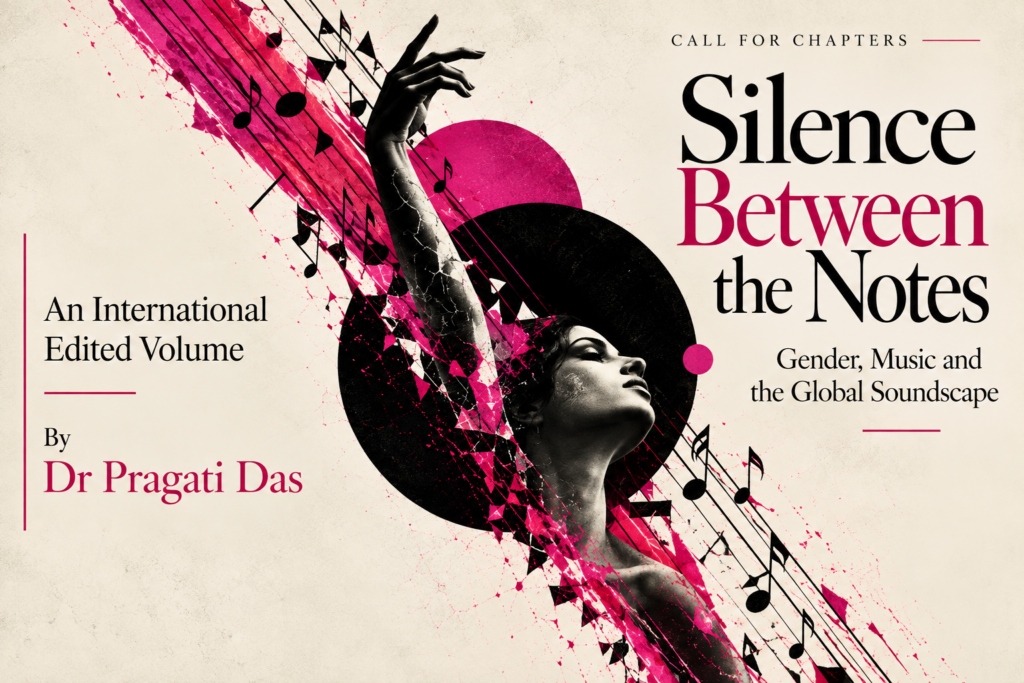
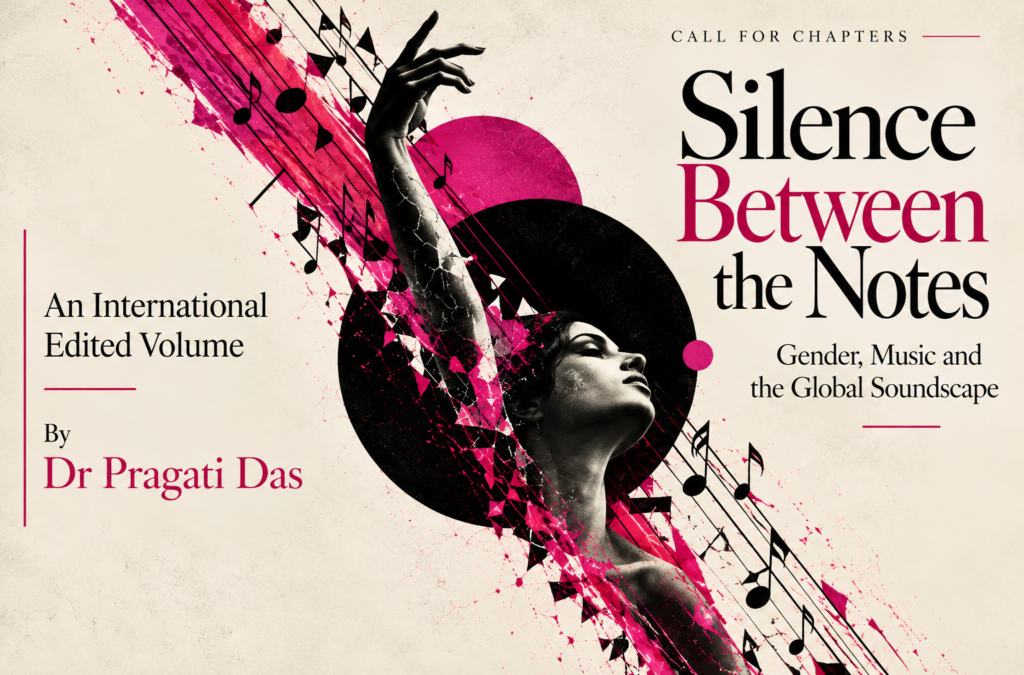
An International Edited Volume
By Dr Pragati Das
Faculty member in the PG and Research Department of English at Bhatter College, Dantan (Autonomous), West Bengal, India
Historically, in music, questions of who is heard, who is represented, who is authorised to speak, and who remains unheard have remained deeply intertwined with gender. The ‘silence’ between the notes, therefore, is the cultural, institutional, and historical spaces in which voices have been marginalised or rendered inaudible. At the same time, silence can become an active space of resistance and alternative voices. In view of these issues, the volume invites theoretically grounded interdisciplinary approaches to music. Feminist musicology offers insights into how musical forms, histories, institutions, and canonical traditions help construct gendered meanings. Susan McClary’s Feminine Endings (1991) opened influential possibilities for reading musical structures and conventions in relation to gender and sexuality. Marcia Citron’s Gender and the Musical Canon (2000) has drawn attention to the historical processes through which women composers and their works have been excluded from established musical canons. These perspectives raise questions about authorship, creativity, musical authority, canon formation and the culturally constructed figure of the musical “genius.”
The volume considers voice and embodiment in relation to the politics of performance. Applying Judith Butler’s theory of gender performativity (Gender Trouble, 1990) to musical contexts shows how vocal timbre, bodily movement, stage presence, performance conventions, and modes of listening can produce gendered identities. Chloë Alaghband-Zadeh’s concept of sonic performativity, developed through her study of North Indian classical vocal music (2015), can be utilised to show how gender may be articulated through vocal practice and culturally recognisable sonic conventions.
Questions of representation and Othering form another important dimension of the volume. Lyrics, music videos, album covers, performance cultures and popular musical narratives construct women and gender minorities as objects or cultural Others. The central questions, therefore, are: who speaks, who is spoken about, whose desire is represented, and who is granted autonomous subjectivity? Laura Mulvey’s concept of the male gaze (1975) and bell hooks’s critique of racialised and gendered representation (Black Looks, 1992) explain the visual construction of the musical body. Edward Said’s Orientalism (1978) and Gayatri Chakravorty Spivak’s writings on subalternity and representation (1988) further open possibilities for examining the interconnectedness of gender, colonial power, cultural difference and the politics of voice.
The volume also encourages intersectional and queer perspectives that resist treating gender as an isolated category. Kimberlé Crenshaw’s theory of intersectionality (1989) is particularly significant for Indian and South Asian musical cultures, where questions of musical respectability, access and authority have been determined by complex social hierarchies. Studies may therefore explore Dalit, Adivasi, minority, working-class, diasporic and queer musical practices alongside more established traditions. R. W. Connell’s theory of masculinities (2005) also enables investigations into the relationship between musical genres, masculine authority, aggression, technological expertise and professional status.
A further concern is the relationship between music, colonial modernity, memory and cultural erasure. Colonial and nationalist formations have contributed to changing binaries of respectable and disreputable performance, classical and popular music, tradition and modernity, and masculine and feminine musical authority. Amanda J. Weidman’s Singing the Classical, Voicing the Modern (2006), for example, shows the importance of examining voice and musical practice within the postcolonial politics of South Indian music. Such approaches can illuminate the histories of the tawa’ifs and devadasi traditions, folk musicians, female performers and other communities whose musical practices have been negotiated through changing structures of morality, caste, respectability and nationalism. Similarly, the absence of women and marginalised musicians from established musical histories may itself be read as an archival silence. Derrida’s insight in Archive Fever (1995) can be used to consider how archives, institutions, and systems of preservation determine what is remembered, catalogued, and canonised and what becomes inaudible.
The volume further recognises that music is embedded within material and institutional structures of labour and technology. Recording studios, educational institutions, publishing industries, festivals, media organisations, streaming platforms and professional networks all participate in determining whose music is produced, circulated and heard. Simon Frith’s Performing Rites (1996) and Lucy Green’s Music, Gender, Education (1997) offer important perspectives on music as a social and cultural practice determined by value, participation and education. These approaches open questions about gendered labour, access to technology, professional networks, production, remuneration and institutional authority.
Finally, Silence Between the Notes looks towards the digital and technological future of gendered sound. Digital production, streaming cultures, algorithmic recommendation, virtual performers, synthetic voices and artificial intelligence are transforming the relationship between the body, voice, technology and musical authorship. Donna Haraway’s cyborg theory (1991), N. Katherine Hayles’s work on virtual embodiment (1999), Rosi Braidotti’s posthumanism (2013) and Karen Barad’s theory of material-discursive entanglement (2007) provide necessary tools for examining these transformations.
This volume therefore brings together interdisciplinary perspectives and seeks to explore the silences, voices, bodies, technologies and power structures that produce the global soundscape. The suggested topics below are indicative rather than exhaustive, and contributors are welcome to propose theoretically rigorous chapters that extend the conceptual and geographical scope of the volume.
Suggested topics:
- Feminist musicology: gender, harmony, rhythm, tonality and musical narrative
- Sonic performativity: voice, timbre, pitch and the cultural construction of gender
- Women as the musical “Other”: desire, objectification and gendered address in popular lyrics
- Female agency, desire and self-representation in songwriting
- Gender, authorship and the politics of musical creativity
- The female composer and the burden of “genius”
- Archival absence, forgotten performers and the making of musical history
- Gender codes and masculine identities across musical genres
- Rock music, electric technology and the construction of masculine musical authority
- The female body on screen: sexualisation, spectatorship and agency in music videos
- The voice as a gendered body: embodiment, vocal identity and performance
- Women producers, engineers and the gender politics of studio culture
- Gender, precarity, professional networks and creative labour
- Tawa’ifs and Devadasi musical traditions: female performers between courtesan culture and modernity
- Gender, caste, sexuality and the reorganisation of performance under colonial modernity
- Dalit women’s songs as counter-memory: oral tradition, caste experience and alternative histories
- Adivasi women’s musical practices: cultural memory, land and community
- Gendered vocality in Hindustani and Carnatic traditions: voice, authority and embodied performance
- The guru–shishya tradition: gender, intimacy and authority
- Bollywood playback singing: female voice, embodiment and the separation of singer and screen body
- Women in Indian hip-hop: voice, language, class, caste and the politics of visibility
- Singing against power: feminist protest songs and political dissent
- Queering the soundscape: non-normative voices, gender identities and alternative musical cultures
- Migrant voices and diasporic soundscapes: gender, belonging, displacement and cultural memory
- Algorithms, streaming platforms and the discoverability of women musicians
- Platform economies and women’s musical careers: visibility, precarity and self-branding
- The synthetic voice: gender, embodiment and authenticity in AI-generated music
- Digital archives, alternative music histories and new forms of access
Author Guidelines
Indexing Possibilities: Indexing possibility in Scopus/WoS is subject to overall book quality and external jury decision.
Timeline
Abstract Submission: October 31 2026
Notification of Acceptance: November 15 2026
Full Chapter Submission (5000-7000 words): December 31 2026
Expected Publication: February 2027.
How to submit
Please send the following as a single Word document:
- Proposed chapter title
- Abstract (300–500 words)
- 3–5 keywords
- Author name and institutional affiliation
- Email address and Phone/WhatsApp number
- Short biographical note (80–100 words)
Stylesheet: APA
Email: pragatidaspogo@gmail.com
Subject line: Silence Between the Notes — Chapter Proposal. [Use the same email thread for all further communications]
Editor

Dr Pragati Das is a faculty member in the PG and Research Department of English at Bhatter College, Dantan (Autonomous), West Bengal, India. She holds a PhD on Leonard Cohen, with her doctoral research examining gender dynamics and the representation of women as the “Other” in Cohen’s lyric poetry. Her research interests include gender studies, music and popular culture, feminist literary studies, representation, and interdisciplinary approaches to literature and music. She is also a founder of the Critical Gender Studies Journal.
by Editor | Jul 19, 2026 | Call for Book Chapters, Edited Volume
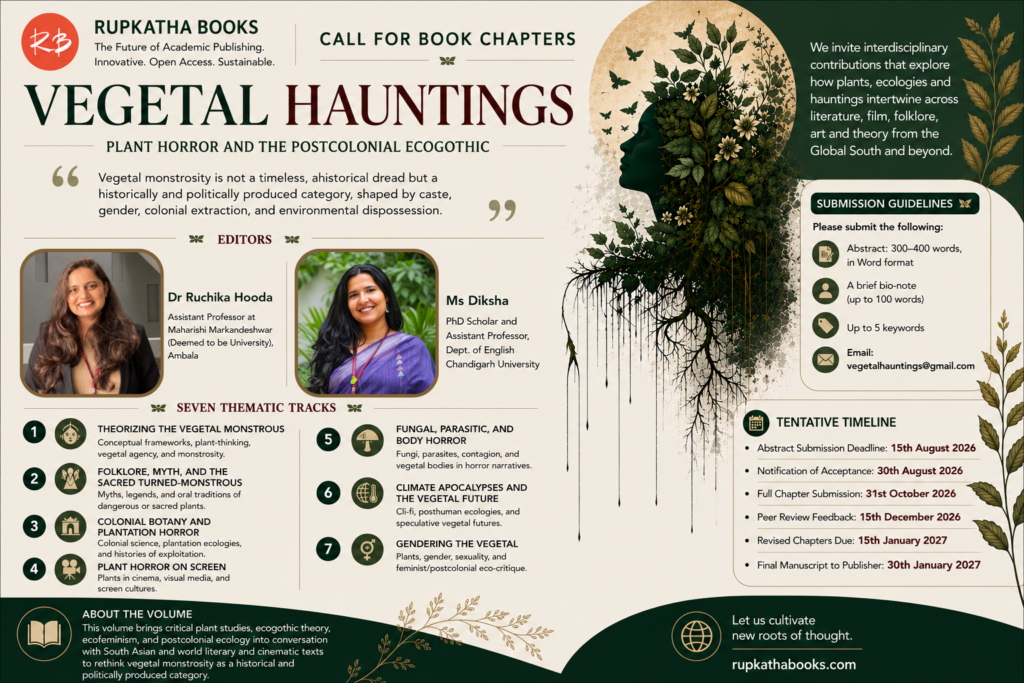
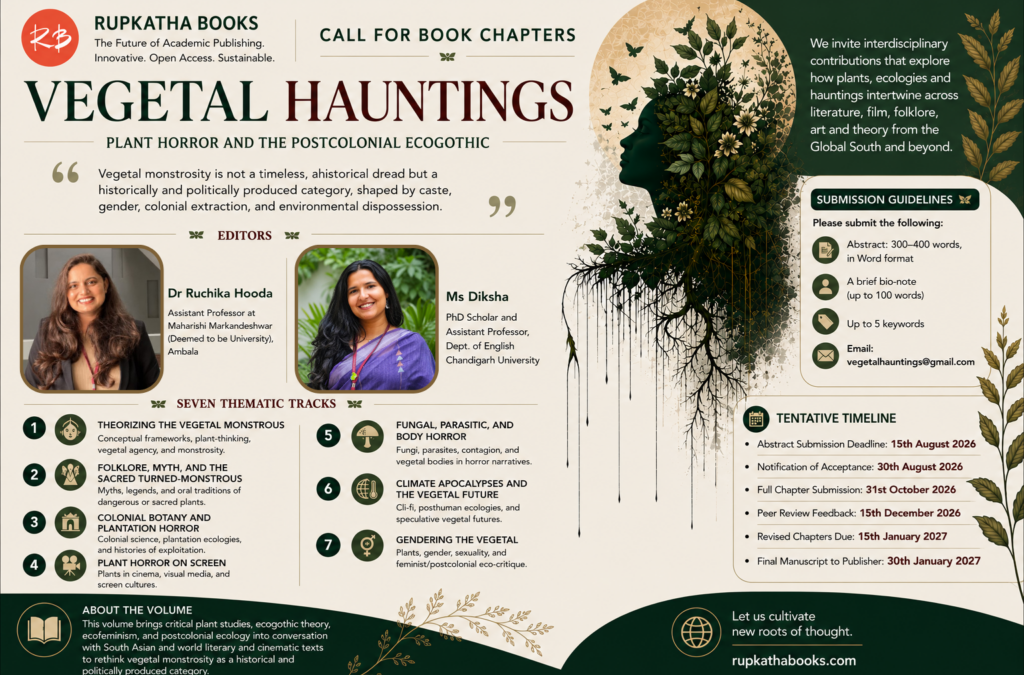
An Edited Volume by
Ruchika Hooda
Assistant Professor at Maharishi Markandeshwar (Deemed to be University), Ambala
Ms. Diksha
Assistant Professor in the Dept. of English at Chandigarh University, Chandigarh
Concept Note
Michael Marder’s foundational claim in Plant-Thinking (2013) is that vegetal life poses a distinct philosophical problem precisely because it resists every category Western thought has used to grant beings significance. Plants have no discernible interiority, no centralised nervous system, and no intentional relation to the world as animals and humans are assumed to have, and this absence has allowed philosophy to treat plant existence as beneath serious inquiry rather than as an unresolved question in its own right. Plant horror, defined as the enduring cultural fascination with predatory vines, sentient forests, carnivorous gardens, and monstrous bloom, has emerged as a recognisable strand of the ecogothic, yet existing scholarship remains overwhelmingly Euro-American in scope and theoretical orientation. The South Asian, postcolonial, and Global South vegetal imagination remains critically underexplored. This book volume proposes to address this gap by bringing critical plant studies, ecogothic theory, ecofeminism, and postcolonial ecology into sustained conversation with South Asian and world literary and cinematic texts.
The most significant scholarly intervention in the field to date, Dawn Keetley and Angela Tenga’s Plant Horror (2016), mapped the recurring tropes of the genre largely across British and American texts. However, it left the postcolonial vegetal imagination almost entirely unexamined. South Asia offers an exceptionally rich archive for this inquiry. Long before plant horror was named as a genre, regional folk traditions had already populated forests and groves with vegetal beings that blur the line between sacred guardian and predatory threat. The yakshi of Kerala’s tree-spirit lore offers the most instructive example of this trajectory: in early Dravidian and Vedic traditions, yakshis were revered as benevolent nature deities, symbolising fertility, beauty, and the protective spirit of the sacred grove or Kavu. Only under the pressures of later patriarchal and Brahmanical religious shifts was their image inverted, from guardian to predator, from deity to vampiric ghost.
Art historians of early Indian religion have long traced this trajectory in the yaksha/yakshi figures themselves. Ananda Coomaraswamy’s foundational study identified these tree-spirits as pre-Vedic, animist deities of fertility and abundance, later incorporated into Brahmanical cosmology. Stella Kramrisch similarly located their origin in indigenous nature-worship that predates and exceeds the subordinate place later religious orthodoxy would assign them. The formative history of colonial botany was imposed upon this, with the result that the plantation, the botanical garden, and the cash crop contributed to the making of horror architectures. Colonial forced plantations of indigo, tea, rubber, and opium uprooted both ecosystems and communities, and that violence resurfaces in literature and cinema, displaced onto Gothic plant imagery. The argument this volume insists on is that vegetal monstrosity is not a timeless, ahistorical dread but a historically and politically produced category, shaped by caste, gender, colonial extraction, and environmental dispossession.
A recurring thread throughout the volume is the persistent gendering of the monstrous plant. Across folklore, fiction, and film, the dangerous plant-being is disproportionately coded as female, seductive, fertile, devouring, and ultimately punished or exorcised at the end of the narrative. Reading the demonisation of these figures as historically produced, configured by caste, gender, and religion rather than arising organically from an ‘ancient’ fear of nature, is itself a theoretical move the volume insists on.
The volume also attempts to situate plant horror as a contemporary mode of climate feeling. As anthropogenic climate change destabilises the boundary between cultivated and wild, plant horror narratives offer one of the few popular vocabularies available for processing the unsettling sense that the vegetal world might no longer remain passive.
The volume invites contributions that explore questions such as
- How do South Asian and postcolonial traditions of plant-being such as folklore, sacred grove ecology, and animist cosmology shape regional inflexions of vegetal horror distinct from those theorised by Western ecocriticism?
- How does the history of colonial botany, the plantation, the botanical garden, the cash crop, function as a horror architecture, encoding environmental and political violence in vegetal Gothic imagery?
- How is the monstrous plant persistently gendered, and what does this reveal about the co-implication of patriarchal and ecological domination?
- What new forms of vegetal horror are emerging in response to climate anxiety, pandemic contagion, and posthuman ecological futures?
- How do literary and cinematic plant horror texts in South Asian languages construct, contest, or revise the genre’s conventions?
- How can indigenous and folk epistemologies of plant agency serve as theoretical resources, rather than mere objects of study, for plant horror scholarship?
- How can critical plant studies be brought into productive dialogue with horror theory to theorize vegetal monstrosity beyond anthropocentric frameworks?
Thematic Tracks
The volume is organized into seven thematic tracks. Contributors are invited to identify the track most relevant to their submission, though cross-track work is encouraged where the material demands it.
- Track 1: Theorising the Vegetal Monstrous
Horror theory has largely been built around creatures that hunt, intend, and violate, categories that sit uneasily with organisms that have no brain and operate on timescales humans can barely perceive. Chapters may ask whether a plant can be truly monstrous without a mind, drawing on Marder, Gagliano, or Hall as theoretical foundations.
- Track 2: Folklore, Myth, and the Sacred-Turned-Monstrous
This track examines oral and religious traditions that coded plants as dangerous long before horror emerged as a genre, centred on Kerala’s yakshi and related Tamil, Sri Lankan, and North Indian tree-spirit figures. Their demonisation must be read as historically produced, shaped by caste, gender, and religion, rather than as natural or inevitable.
- Track 3: Colonial Botany and Plantation Horror
This track treats the empire’s relationship to plants as the historical engine of vegetal horror, with colonial monoculture uprooting ecosystems and communities, and that violence resurfacing as overgrown plantations and retaliating crops. Indigo-plantation literature and tea-garden fiction from Assam and Bengal offer natural source material.
- Track 4: Plant Horror on Screen
This track turns to film studies, examining how forests, roots, and vines generate dread through cinematography and sound design rather than narration alone. South Asian horror cinema, including Tumbbad, Bulbbul, and Malayalam and Tamil Yakshi films, offers rich, under-theorised material.
- Track 5: Fungal, Parasitic, and Body Horror
The volume’s most contemporary track connects plant horror to post-pandemic infection narratives, covering mycelial and fungal horror, spore-spread, and human-plant hybridity. Contributors may draw on posthumanism and new materialism to treat the porous boundary between human and vegetal bodies.
- Track 6: Climate Apocalypse and the Vegetal Future
This track covers speculative fiction where vegetal overgrowth or plant rebellion functions as climate allegory, drawing on Albrecht’s solastalgia and Nixon’s slow violence. It welcomes both dystopian readings of nature’s revenge and more hopeful, restorative posthuman futures.
- Track 7: Gendering the Vegetal
A cross-cutting ecofeminist track theorising the persistent coding of dangerous plant figures as female, from the yakshi to the devouring garden, drawing on Plumwood and Warren’s linking of woman and nature as twin categories of otherness. It may stand alone or cross-cut Tracks 2 and 4.
Submission Guidelines
Please submit the following:
- Abstract: 300-400 words, in Word format
- A brief bio-note (up to 100 words)
- Up to 5 keywords
- Email: editors.vegetalhauntings@gmail.com
Selected contributors will be invited to submit full-length chapters of approximately 5,000–7,000 words, including references. Chapters should follow APA style. Submissions must be in MS Word (.docx) format. All chapters will be subjected to plagiarism and AI detection through Turnitin, Grammarly and Copyleaks. Once the reports are satisfactory, chapters undergo double-blind peer review.
Author Guidelines
Indexing Possibilities: Indexing possibility in Scopus/WoS is subject to overall book quality and external jury decision.
Tentative Timeline
- Abstract Submission Deadline: 15th August 2026
- Notification of Acceptance: 30th August 2026
- Full Chapter Submission: 31st October 2026
- Peer Review Feedback: 15th December 2026
- Revised Chapters Due: 15th January 2027
- Final Manuscript to Publisher: 30th January 2027
Submission and Queries
- Please send abstracts and inquiries to: editors.vegetalhauntings@gmail.com
- Please use the subject line: ‘Vegetal Hauntings – Abstract Submission – [Your Name]’
- Queries about scope, track fit, or submission procedures are welcome before the abstract
Why Publish with Rupkatha Books?
Rupkatha Books is an international open-access academic publisher committed to disseminating high-quality scholarship across the humanities and social sciences. Authors benefit from:
- International affiliations
- Rigorous double-anonymous peer review and international editorial standards
- Open-access dissemination, global discoverability and scholarly visibility
- DOI assignment for individual chapters, Crossref registration with metadata
- Copyrights kept by authors.
- Worldwide readership across academic communities
Volume Editors
Ruchika Hooda is an Assistant Professor at Maharishi Markandeshwar (Deemed to be University), Ambala. She holds a PhD (2023) and an MPhil (2020) in English from Maharshi Dayanand University. She has served as an Assistant Professor at Chandigarh University and as a Guest Skill Assistant Professor at Shri Vishwakarma Skill University. She is currently a member of the editorial board of The Criterion: An International Journal in English (ISSN: 0976-8165). She has edited the book Writing the Living World (ISBN: 978-93-81818-96-1). Her research interests include Indian English Literature, mythology, and environmental humanities, with a focus on Alternate History and Deep Ecology, emphasising eco-conscious literary inquiry.
Diksha is a PhD scholar and Assistant Professor in the Dept. of English at Chandigarh University, where she teaches undergraduate and postgraduate courses in communication. Her scholarly work operates at the confluence of posthumanism, ecocriticism, trauma theory, and feminist theory, with sustained attention to contemporary fiction. With over 4.5 years of teaching experience, she is committed to intellectual rigour and pedagogical vitality and cultivates in her students a capacity for critical inquiry and meaningful engagement with literature, language, and the wider world.

by Editor | Jul 17, 2026 | Call for Book Chapters, CFP-Book-Series, Edited Volume
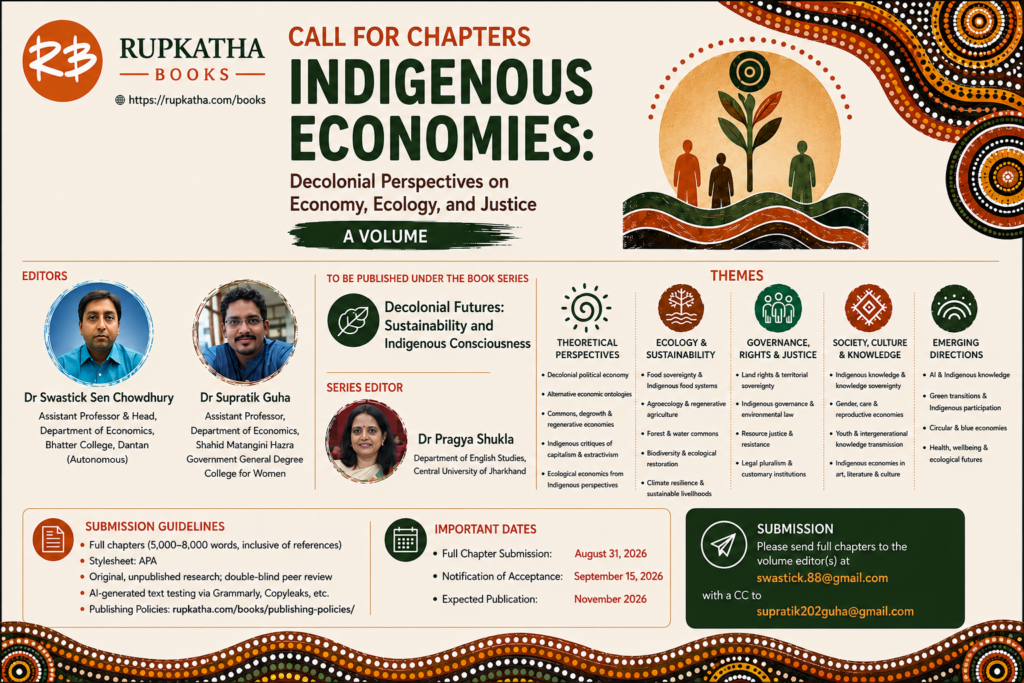
A Volume
Editors
Dr Swastick Sen Chowdhury
Assistant Professor & Head in the Department of Economics, Bhatter College, Dantan (Autonomous)
Dr Supratik Guha
Assistant Professor, Department of Economics at Shahid Matangini Hazra Government General Degree College for Women
To be published under the book series
Decolonial Futures: Sustainability and Indigenous Consciousness
About the Volume
The twenty-first century is witnessing profound crises of economy, ecology, and democracy. Climate change, biodiversity loss, extractivism, food insecurity, forced displacement, and widening social inequalities have exposed the limitations of dominant economic paradigms rooted in colonialism, capitalism, and endless growth. These interconnected crises call not merely for policy reform but for a fundamental rethinking of how economies are imagined, organised, and sustained.
In recent decades, scholars have increasingly turned towards concepts such as the pluriverse, Buen Vivir, Ubuntu, the commons, degrowth, regeneration, political ontology, and relationality to imagine alternatives to Eurocentric models of development. Indigenous knowledge systems have become central to these conversations, offering sophisticated understandings of reciprocity, collective stewardship, ecological interdependence, and community well-being. Rather than treating nature as a resource to be exploited, Indigenous worldviews conceive land, forests, rivers, animals, and human communities as interconnected participants in living ecological relationships.
This volume proposes Indigenous economies as a critical theoretical framework for understanding these alternative modes of existence. Indigenous economies are not simply subsistence systems or local adaptations; they represent complex social, cultural, ecological, ethical, and political formations that challenge extractive capitalism and colonial modernity. They foreground collective responsibility over individual accumulation, regeneration over extraction, and relationality over commodification.
Bringing together scholars from across the humanities, social sciences, environmental studies, law, geography, anthropology, economics, political ecology, and Indigenous studies, this volume seeks to examine how Indigenous economic thought contributes to contemporary debates on sustainability, climate justice, ecological restoration, food sovereignty, and decolonial futures.
The editors particularly welcome contributions that develop new theoretical frameworks, critically engage existing paradigms, or provide empirically grounded analyses capable of advancing international debates on decolonial political economy and ecological justice.
Suggested Themes
Contributors may address, but are not limited to, the following themes:
Theoretical Perspectives
- Indigenous economies as decolonial political economy
- The pluriverse and alternative economic ontologies
- Political ontology, relationality, and Indigenous philosophies
- Buen Vivir, Ubuntu, Swaraj, and other non-Western economic imaginaries
- Commons theory and community economies
- Degrowth, post-growth, and regenerative economies
- Indigenous critiques of capitalism, neoliberalism, and extractivism
- Ecological economics from Indigenous perspectives
Ecology and Sustainability
- Food sovereignty and Indigenous food systems
- Agroecology and regenerative agriculture
- Forest economies and community conservation
- Water commons and Indigenous governance
- Biodiversity, biocultural diversity, and ecological restoration
- Climate adaptation and resilience
- Environmental justice and ecological citizenship
- Sustainable livelihoods and local innovations
- Ecology and Nature Based Solutions
Governance, Rights, and Justice
- Land rights and territorial sovereignty
- Indigenous governance and environmental law
- Resource justice and resistance to extractivism
- Community-based natural resource management
- Indigenous movements and environmental activism
- Decolonising development policy
- Legal pluralism and customary institutions
Society, Culture, and Knowledge
- Indigenous knowledge systems and knowledge sovereignty
- Oral traditions and ecological knowledge
- Indigenous entrepreneurship and cooperative economies
- Gender, care, and reproductive economies
- Youth, education, and intergenerational knowledge transmission
- Indigenous data sovereignty and digital futures
- Indigenous economies in literature, film, art, and visual culture
- Comparative Indigenous economies across the Global South
- Indigenous-informed frameworks for restoring environmental and human well-being
Integrating Indigenous Knowledge with Mainstream Health Care Practices
- Co-producing knowledge upholding Indigenous ontologies alongside mainstream tradition
- Tracing the continuum of indigenous healthscapes from ancestral balance, colonial disruption and future reconnection
- Co-designing health structures with indigenous communities
Emerging Directions
- Artificial intelligence and Indigenous knowledge
- Green transitions and Indigenous participation
- Circular and regenerative economic models
- Blue economies and Indigenous coastal communities
- Urban Indigenous economies
- Tourism, heritage, and community development
- Food Security, Health, wellbeing, and ecological futures
Submission Guidelines
- Authors are invited to submit full chapters of 5,000–8,000 words, inclusive of references.
- Stylesheet: APA
- All submissions must present original, unpublished research and will undergo double-blind peer review.
- All submissions will undergo AI-generated text testing through Grammarly, Copyleaks, etc.
- Publishing Policies: https://rupkatha.com/books/publishing-policies/
- Please send full chapters to the volume editor(s) at swastick.88@gmail.com with a CC to supratik202guha@gmail.com
Important Dates
- Full Chapter Submission: August 31 2026
- Notification of Acceptance: September 15 2026
- Expected Publication: November 2026
About the Book Series
Decolonial Futures: Sustainability and Indigenous Consciousness is an interdisciplinary book series published by Rupkatha Books. The series promotes theoretically rigorous and globally engaged scholarship that foregrounds Indigenous epistemologies, ecological wisdom, environmental justice, and decolonial approaches to sustainability. It provides a platform for innovative research exploring plural ways of knowing, being, and inhabiting the world while contributing to contemporary debates on ecological resilience, social justice, and sustainable futures.
Series Editor
Dr Pragya Shukla
Assistant Professor, Department of English Studies, Central University of Jharkhand
General Editor
Dr Tarun Tapas Mukherjee
Associate Professor, PG Department of English, Bhatter College, Dantan (Autonomous), India

by Editor | Jun 17, 2026 | Book Chapter, Edited Volume, Urban Imaginaries and Indian Cities in Literature
Dr. Sudakshina Bhattacharya¹ , Dr. Sulagna Mohanty² & Dr. Ankusha Bandyopadhyay³
¹ ³Assistant Professor (Sr. Gr), Department of English & Humanities, Amrita School of Arts, Humanities & Commerce, Coimbatore, Amrita Vishwa Vidyapeetham, India. *Corresponding author.
²Assistant Professor, Department of Language, Culture and Society, Faculty of Engineering & Technology, SRM Institute of Science and Technology, Kattankulathur, Chennai.
 10.21659/9788197513022.08
Abstract
The concept of spatiality in India is continually evolving with transitions in the social, cultural, political, and economic spheres, shaping our perspectives on spatiality. India is now beginning to be recognised not only as a principally rural and agrarian country but is also attracting notice for its urban spaces and urbanity, including its innate intricacies. The Indian scholarship in this direction is proliferating in commendable ways. Apart from the critical enquiries, several writers have produced brilliant literary works about Indian cities, like Khuswant Singh, Amitav Ghosh and Mamang Dai, to name only a few. However, an extensive literature review reveals that a minimal eclectic analysis is seen about the smaller urban places in India, such as Sikkim’s capital city, Gangtok. Our study stems from this huge research gap because the process of urbanisation is happening ubiquitously in India, and hence, scholarly probes cannot be limited to the comprehension of the established Indian metropolises alone. Through an interpretive analysis of Satyajit Ray’s detective fiction Trouble in Gangtok (1971) and the documentary film titled Sikkim (1971), and Prajwal Parajuly’s novel Land Where I Flee (2014), the present research attempts to understand the urban nuances of Gangtok within the broad framework of spatial studies to highlight the existence of unique Indian urbanity.
Keywords: Spatial turn, Urbanity, Gangtok, Satyajit Ray, Prajwal Parajuly.
Full-Text Chapter PDF Full Text Book PDF
Urban Imaginaries and Indian Cities in Literature
Table of Contents
Front Matter
Urban Imaginaries and Indian Cities in Literature: An Introduction
Dr. Neethu P Antony and Dr. Arpana Venu
Abstract Full Text PDF
City as Micro-Narratives of Senses and Everyday Experiences: An Analytical Study of Selected Stories from People Called Kolkata
Olivia Joseph
Abstract Full Text PDF
Multilingual Metropolis: The Politics of Language and Belonging in Guwahati Through Sheelabhadra’s Fiction
Sangeeta Bhagawati
Abstract Full Text PDF
Spatial (re)orientations and Epic structures of the urban in Fareeda Mehta’s Kali Salwaar
Elroy Pinto
Abstract Full Text PDF
Between Tramline and Traffic Jam: Mapping Indian City through Satyajit Ray’s Mahanagar and Anurag Basu’s Life in a…Metro
Trisha Sengupta & Dr. Sanghamitra Baladhikari
Abstract Full Text PDF
Reimagining Kolkata: Subaltern Narratives and the Colonial Urban Dystopia in Kallol Magazine’s Literature
Nandini Gayen
Abstract Full Text PDF
Walking, Writing and Resisting the City: Spatial Tactics and Postcolonial Reimaginings in Janice Pariat’s Everything the Light Touches
Parvin Sultana
Abstract Full Text PDF
Mimesis, Montage and Mapping: A Spatial Analysis of Gangtok City Scapes in the Select Works of Satyajit Ray and Prajwal Parajuly
Dr. Sudakshina Bhattacharya, Dr. Sulagna Mohanty, and Dr. Ankusha Bandyopadhyay
Abstract Full Text PDF
by Editor | Jun 17, 2026 | Book Chapter, Edited Volume, Urban Imaginaries and Indian Cities in Literature
Parvin Sultana
Assistant Professor, P.B. College, Gauripur, Assam, India.
10.21659/9788197513022.07
Abstract
This paper examines Janice Pariat’s Everything the Light Touches (2022) as a complex meditation on space, memory, and decolonial resistance. It analyses the novel’s nonlinear narrative and its shifting portrayals of urban and natural landscapes and argues that Pariat constructs what Doreen Massey terms a “thrown-togetherness” of place. Her articulation of space is chaotic yet generative, marked by vitality and multiplicity. The study explores how characters inhabit postcolonial terrains through practices such as walking and dwelling at the margins, and how these acts become modes of negotiating identity. It also contends that Pariat’s fragmented storytelling mirrors the fractured condition of postcolonial subjectivity. Thus, it also opens pathways to alternative epistemologies and Indigenous knowledge systems.
Keywords: postcolonial literature, spatial theory, decolonial ecology, Indigenous epistemology, walking, place-making.
Full-Text Chapter PDF Full Text Book PDF
Urban Imaginaries and Indian Cities in Literature
Table of Contents
Front Matter
Urban Imaginaries and Indian Cities in Literature: An Introduction
Dr. Neethu P Antony and Dr. Arpana Venu
Abstract Full Text PDF
City as Micro-Narratives of Senses and Everyday Experiences: An Analytical Study of Selected Stories from People Called Kolkata
Olivia Joseph
Abstract Full Text PDF
Multilingual Metropolis: The Politics of Language and Belonging in Guwahati Through Sheelabhadra’s Fiction
Sangeeta Bhagawati
Abstract Full Text PDF
Spatial (re)orientations and Epic structures of the urban in Fareeda Mehta’s Kali Salwaar
Elroy Pinto
Abstract Full Text PDF
Between Tramline and Traffic Jam: Mapping Indian City through Satyajit Ray’s Mahanagar and Anurag Basu’s Life in a…Metro
Trisha Sengupta & Dr. Sanghamitra Baladhikari
Abstract Full Text PDF
Reimagining Kolkata: Subaltern Narratives and the Colonial Urban Dystopia in Kallol Magazine’s Literature
Nandini Gayen
Abstract Full Text PDF
Walking, Writing and Resisting the City: Spatial Tactics and Postcolonial Reimaginings in Janice Pariat’s Everything the Light Touches
Parvin Sultana
Abstract Full Text PDF
Mimesis, Montage and Mapping: A Spatial Analysis of Gangtok City Scapes in the Select Works of Satyajit Ray and Prajwal Parajuly
Dr. Sudakshina Bhattacharya, Dr. Sulagna Mohanty, and Dr. Ankusha Bandyopadhyay
Abstract Full Text PDF
by Editor | Jun 17, 2026 | Book Chapter, Edited Volume, Urban Imaginaries and Indian Cities in Literature
Nandini Gayen
Research Scholar, Department of English, Banaras Hindu University.
10.21659/9788197513022.06
Abstract
Kallol (1923-1929), a prominent literary magazine of Bengal published under the joint editorship of Dineshranjan Das and Gokulchandra Nag, became a mouthpiece for challenging the dominant Bhadralok hegemony in the Bengal Presidency. As the colonial capital and centre of modernisation, Kolkata was both a place of hope and frustration for young migrants arriving from mofussil towns in search of better lives. However, the Bhadralok account, disseminated by the city’s bourgeoisie, tended to overlook the realities experienced by the underbelly. Kallol, as a cultural and literary movement in Bengal, portrayed Kolkata as a city of stark contrasts, defined by fragmented spaces and marginalised lives. Drawing on Lefebvre’s conception of space as a political construct and Certeau’s framework of tactics versus strategies, this paper analyses how Kallol’s stories, poems, and essays expose the city’s “third spaces” of resistance, where marginalised clerks, labourers, and migrants navigate oppressive urban hierarchies. By closely reading the texts that appeared in Kallol, this article examines how the cityscape of Kolkata becomes a place where illusions of progress are subverted by economic exploitation, poverty, and the erosion of human dignity. These urbanscapes in Kallol stand not only for physiographic locations but also for psychological topographies that bring to the fore the desperation of clerks confined to demeaning jobs, labourers exploited in industrial areas, and families suffering from squalor and uncertainty. This portrayal underpins the attempt to constitute Kolkata as a fractured entity, where the relentless pace of modernisation left its residents in disconnection, disillusionment, and confinement within its dystopian boundaries. This paper will trace the contours of an uncompromised critique of Kallol in reimagining Kolkata as a dystopian space that reveals the human cost of colonial modernity and rapid urbanisation.
Keywords: Urban Dystopia, Elite Hegemony, Spatial Politics, Colonial Urbanism, Resistance, Subaltern Agency, Fragmented Cityscapes.
Full-Text Chapter PDF Full Text Book PDF
Urban Imaginaries and Indian Cities in Literature
Table of Contents
Front Matter
Urban Imaginaries and Indian Cities in Literature: An Introduction
Dr. Neethu P Antony and Dr. Arpana Venu
Abstract Full Text PDF
City as Micro-Narratives of Senses and Everyday Experiences: An Analytical Study of Selected Stories from People Called Kolkata
Olivia Joseph
Abstract Full Text PDF
Multilingual Metropolis: The Politics of Language and Belonging in Guwahati Through Sheelabhadra’s Fiction
Sangeeta Bhagawati
Abstract Full Text PDF
Spatial (re)orientations and Epic structures of the urban in Fareeda Mehta’s Kali Salwaar
Elroy Pinto
Abstract Full Text PDF
Between Tramline and Traffic Jam: Mapping Indian City through Satyajit Ray’s Mahanagar and Anurag Basu’s Life in a…Metro
Trisha Sengupta & Dr. Sanghamitra Baladhikari
Abstract Full Text PDF
Reimagining Kolkata: Subaltern Narratives and the Colonial Urban Dystopia in Kallol Magazine’s Literature
Nandini Gayen
Abstract Full Text PDF
Walking, Writing and Resisting the City: Spatial Tactics and Postcolonial Reimaginings in Janice Pariat’s Everything the Light Touches
Parvin Sultana
Abstract Full Text PDF
Mimesis, Montage and Mapping: A Spatial Analysis of Gangtok City Scapes in the Select Works of Satyajit Ray and Prajwal Parajuly
Dr. Sudakshina Bhattacharya, Dr. Sulagna Mohanty, and Dr. Ankusha Bandyopadhyay
Abstract Full Text PDF