Rupkatha Journal on Interdisciplinary Studies in Humanities

Editorial, Volume V, Number 3

538 views

With this edition (Vol. V, No. 3) the Rupkatha Journal on Interdisciplinary Studies in Humanities completes five years of its glorious presence online. The journal was conceived mainly as a scholarly platform seeking standardization of scholarship and research, and as an online experiment helped by the Web 2.0 phenomenon for dissemination and access in non-profit model on a user-friendly interface on the digital media. With the very first issue we took up measures for standardizing its publishing system following certain established global norms, and the journal began to be recognized by scholarly indexing, archiving and directory and library services like EBSCO, Elsevier Scopus, MLA, DOAJ, Archive-it etc. But the biggest recognition and acceptance came from scholars who contributed to it as readers, authors and editors. We have been trying very hard in spite of being a non-profit initiative, to improve the quality with every issue and introduced new user-friendly services following certain norms—scholarly, ethical, technical. New areas were selected for research and enquiry, and new scholarly voices were encouraged and promoted. Several special issues were brought out successfully with much enthusiasm from different parts of the globe. Keep Reading

Editorial: Special Issue on Performance Studies

//
365 views

In this edition of Rupkatha we have the privilege of incorporating an introductory essay by Richard Schechner, in which he once again valorizes the anthropological foundations of performance studies and goes on to refer towards the infallible necessity of observing behaviour as a kind of transbiological agency and of tracing its effects in theatre and other kinds of representations. Schechner belongs to a tradition of performance scholars who believed in a kind of large, scientific ontology for the arts, a tendency which is evident when he quotes a New York University scholar. Perhaps the objective vision of a performance continuum is instructive for the future, as it creates an immediate stance, of both engaging as well as transcending the flow of experience in our lives which are organized and controlled  by means of mimetically emerging actions. The performer acquires, in Schechner’s scheme, as a liminal activist, so wonderfully described by anthropologist Victor Turner, and analysed in the scientism of Geertz’ observations of culture as an influential medium in which the arts and performances get endowed with signification. Keep Reading

Call for Reviewers and Copy-editors

1.9K views

Peer-ReviewReviewers

We invite applications from established scholars to act as Reviewers for the Rupkatha Journal (www.rupkatha.com). Reviewers  familiar with OJS (Open Journal System) and/or other platforms for online review will be preferred as we will introduce new system of online review in 2014. Interested scholars need to send the following in their CV:

  1. Institutional affiliation details along with associations with other journals;
  2. Areas of specialization and expertise;
  3. List of published works.
  4. A small photograph.

Preferred Areas of Specialization: Aesthetics, Cultural Studies, Cultural Anthropology, Visual Arts, Music, Digital Humanities, Electronic Literature, French Literature, Spanish Literature, Latin American Literature, Animal Studies, Classical European Literature, Classical Indian Literature. (We are not looking for specializations in the areas like Indian English Writings, Postcolonial Literature etc) Nature of the work: All the submitted articles and book reviews go through Double-blind Peer Review process. A reviewer gets only one article for anonymous review for any issue and s/he needs to submit the report within one month. The Rupkatha Journal is a non-profit open access initiative and so nobody associated with the journal gets paid. This is a non-monetary voluntary service for the academic community. No remuneration: Since the journal is a non-profit academic initiative, reviewers will not be paid any amount. They should consider it a voluntary academic service. However, we can provide them with Experience Certificate if needed. Please send your CV to editor@rupkatha.com.

Copy-editors

Candidates should have the following essential skills:

  • An excellent command of the English language
  • Good knowledge in literature for spotting factual errors
  • Logical skill to recognize inconsistencies or vagueness
  • Love for perfection
  • Passion for Open Access
  • Aesthetic sense
  • Time to meet deadline
  • And finally, good command over any of the Word Processors, MS Word or Open Office

Educational qualification: Postgraduate in English literature or Linguistics No remuneration: Since the journal is a non-profit academic initiative, Copy-editors will not be paid any amount. They should consider it a voluntary academic service. However, we can provide them with Experience Certificate if needed. Please send your CV to editor@rupkatha.com.

Stillness of star-less nights: Afghan Women’s Poetry of Exile

1K views

Rumpa Das, Maheshtala College, South 24 Parganas, India

Download PDF Version

 Abstract

Contemporary English poetry by Afghan women presents a remarkable reading experience. Critical explorations, at ease with post-colonial conditions, minority solitude and feminist readings, have largely remained inimical to the unique, yet chequered history that women poets such as Zohra Saed, Sahar Muradi, Sara Hakeem, Fatana Jahangir Ahrary, Fevziye Rahzigar Barlas and Donia Gobar document in their works. Most of them write in their native Dari and Pushtun languages as well as in English and often their English compositions have smatterings of their native tongues. Even though individual experiences differ, these women delve into the collective memory of oppression, pain and unrest to give vent to their feelings, and seek to reach out towards a sorority of shared angst. This paper seeks to explore the complex cultural contexts which have given birth to Afghan women’s poetry in exile. Keep Reading

The Poetics of John Ashbery

1.8K views
Gargi Bhattacharya, Rabindra Bharati University

Download PDF Version

Abstract

John Ashbery (1927- ) takes the postmodernist polysemy of meaning in interpreting a work of art and the polyphony of styles in composing as his forte. He questions the various linguistic codes and makes us aware of the artificiality of the language. All political, ethical and aesthetic imperatives are rhetorical constructs. The writer uses language to persuade the reader to accept the formulated truth and he intervenes in the process of perception by his/her politics of representation. Though his iconoclastic approach towards writing and individuality of style has kept him aloof from mainstream academic syllabi, yet he has now become a prominent figure in Contemporary American Literature. It is interesting to note how Ashbery’s poetry revives the Romantic sensibility while applying the digitalized methods and the postmodern syndromes of immediacy, indeterminacy, disjunctive syntax, open-ended and multiplicity of interpretations. This paper explores the aesthetics of John Ashbery’s poetry. Keep Reading

Bob Dylan’s Folk Poetics in the Later Albums: Telling the Story of America in Ruins in Simple Poetic Language

1.7K views

Matt Shedd, University of Oregon, USA

Download PDF Version

Abstract

Bob Dylan’s recent albums have returned to a more basic sense of American vernacular and poetics, employing stock phrases that evoke a rural America of the past. However, the past does not provide any shelter from modern day angst and impending devastation. We see this particularly in the 2001’s Love and Theft, coincidentally released on the day of the Twin Towers attack. By foregoing concepts of radical artistic individuality, Dylan use more traditional folk poetics to provide a historical and communal account of the descent of the United States into what Dylan calls “an empire in ruins.” Keep Reading

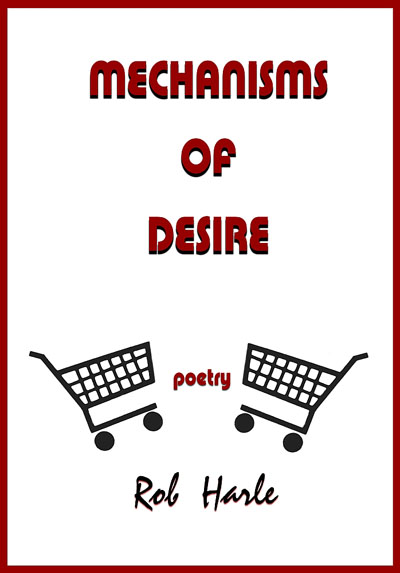
Book Review: Mechanisms of Desire by Rob Harle

395 views

  Mechanisms of Desire by Rob HarlePublisher: Spinning Spider Publications, Australia

Published in 2012

ISBN:978-0-646-57481-3

Price: Not mentioned.


Review by

Tarun Tapas Mukherjee

Bhatter College, Dantan, India

 PDF Version of the review

Evolutionary history of mankind is interrelated with the evolution of technology in a very complex way and so much so that in order to understand patterns of cultures of the distant prehistoric times researchers resort to understanding techno-complex, the archaeological imprint of technology to be found across scattered evidences. Technology, again, creates epochs and can cause massive changes in the ways of life. While people adopt new ways of life with every major technological changes, concerns about the outcome of application of a new technology are also are heard. It was, however, not until the implementation of digital technology in embedded systems serious moral and ethical questions would be raised about using technology in popular media and serious literature. In the present century, with the introduction of embedded systems, many of which function in networked environments, use of technology has increased at unprecedented rate. Even sometimes some gadgets are being treated as an extension of our bodily organs and mental faculties. This sometimes is interpreted as mindless rush for consumerism. On a more serious note, many see the human-machine proximity and even incorporation of digital parts as another stage of evolution, set to bring about unexpected and unpredicted changes. Keep Reading