by Editor | Jun 27, 2026 | Uncategorized
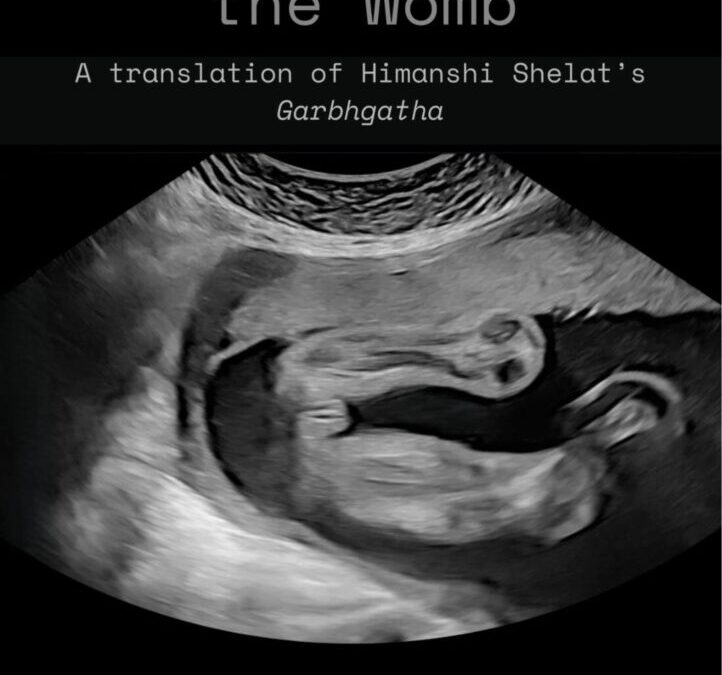
Stories from the Womb: A translation of the Sahitya Akademi Award-winning author Himanshi Shelat’s Garbhgatha
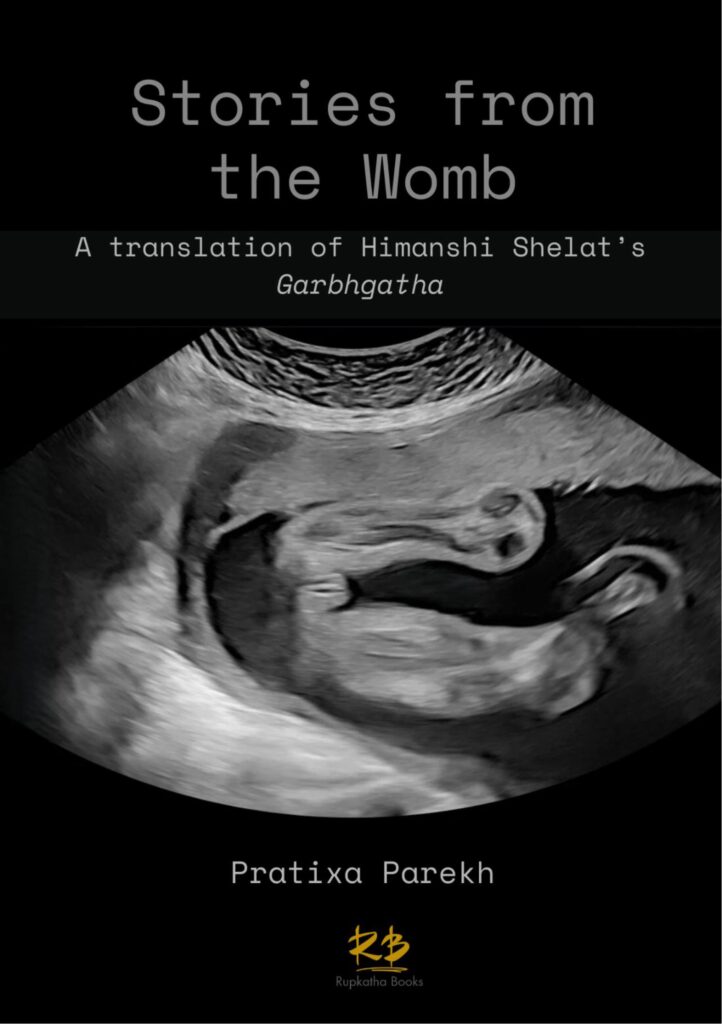
Bibliographic Details
- Publisher: Rupkatha Books (Imprint), Aesthetix Media Services (OPC) Private Limited; First edition ( 2025), under Rupkatha Translation Project 2025
- Language: English
- Ebook: 68 pages
- ISBN-13: 978-81-975130-5-3
- DOI: https://doi.org/10.21659/rtp04
- PDF Link: Free Access
- License: CCNC
- Dimensions: 17.6 cm x 25 cm
- Country of Origin: India
About the Book
Stories from the Womb is a powerful and deeply moving novella by acclaimed Sahitya Akademi Award-winning Gujarati writer Himanshi Shelat, brought to English readers in a sensitive translation by Dr Pratixa Parekh. Blending folklore, myth, and stark social realism, the narrative gives voice to Asti, an unborn girl who struggles to save herself from female foeticide by telling stories to her mother from within the womb. Echoing the storytelling tradition of One Thousand and One Nights, each tale uncovers hidden histories of women whose lives have been shaped by silence, patriarchy, violence, and resilience. As the stories unfold, the boundaries between memory, myth, and lived experience dissolve, compelling the mother to confront the injustices that generations of women have endured. Richly rooted in Gujarati culture yet universal in its emotional appeal, the novella explores motherhood, gender discrimination, reproductive rights, and the transformative power of storytelling. Both an important feminist intervention and a remarkable literary achievement, Stories from the Womb speaks to contemporary debates on gender justice while celebrating the enduring strength of women’s voices. This elegant translation preserves the lyrical beauty and emotional intensity of the original, making Himanshi Shelat’s extraordinary work accessible to readers across cultures and languages.
.
Dr Pratixa Parekh is a translator and academician currently serving as Assistant Professor of English at Dolat-Usha Institute of Applied Sciences and Dhiru-Sarla Institute of Management & Commerce, Valsad, Gujarat, since 2006. She has presented and published research in numerous national and international forums, with interests spanning Comparative Studies, Translation Studies, and Gender Studies. Her translations of Gujarati fiction and poetry into English have appeared in esteemed journals such as Indian Literature, Sahityasetu, Translation Today, and Sahitya. Notably, her translated short story features in the anthology Redolent Rush: Contemporary Indian Short Fiction in Translation (Hawakal Publishers, Kolkata).
Dr Himanshi Shelat (b. 1947, Surat) is a renowned Gujarati author and Sahitya Akademi Award recipient, celebrated for her psychologically nuanced and socially conscious fiction. Holding an M.A. and a PhD in English, she taught at M.T.B. Arts College, Surat, until 1994. Her literary journey began in 1978, and she gained nationwide recognition with Andhari Galima Safed Tapakan (1992). Influenced by Mahasweta Devi and Jane Austen, Shelat’s writing delves into everyday realities, marginalised lives, and women’s struggles, often inspired by her social welfare work. Her oeuvre includes acclaimed story collections (Antaral, Ae Loko) and novels (Aathamo Rang, Saptadhara), as well as essays, memoirs, and literary criticism. She has also edited numerous volumes and served on the Sahitya Akademi advisory board (2013–2017). In 2024, she was honoured with the Kuvempu Rashtriya Puraskar. Married to Vinod Meghani, son of poet Jhaverchand Meghani, Shelat remains a vital voice in post-modern Gujarati literature.
by Editor | Jun 27, 2026 | Poetry Translation, Translation
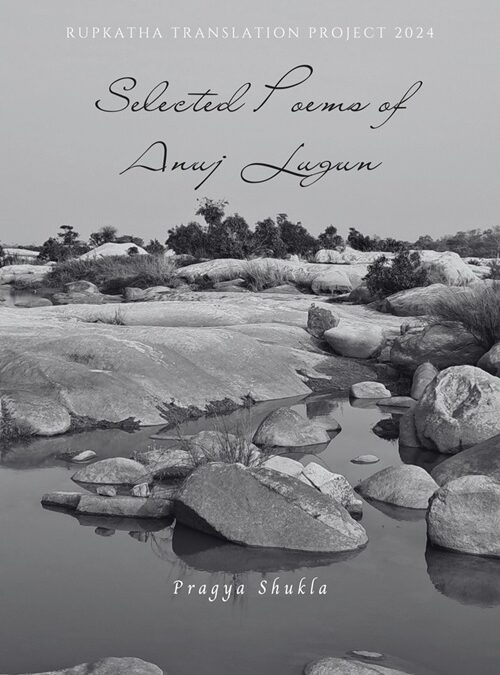
Selected Poems of Anuj Lugun
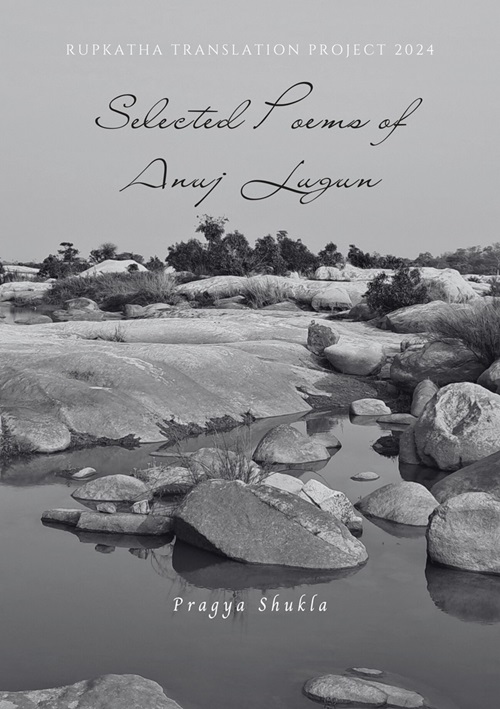
Bibliographic Details
- Publisher: Rupkatha Books (Imprint), Aesthetix Media Services (OPC) Private Limited; First edition (2024), under Rupkatha Translation Project 2024
- Language: English
- Ebook: 46 pages
- ISBN-13: 978-81-975130-7-7
- DOI: https://doi.org/10.21659/rtp01
- PDF Link: Free Access
- License: CCNC
- Dimensions: 17.6 cm x 25 cm
- Country of Origin: India
About the Book
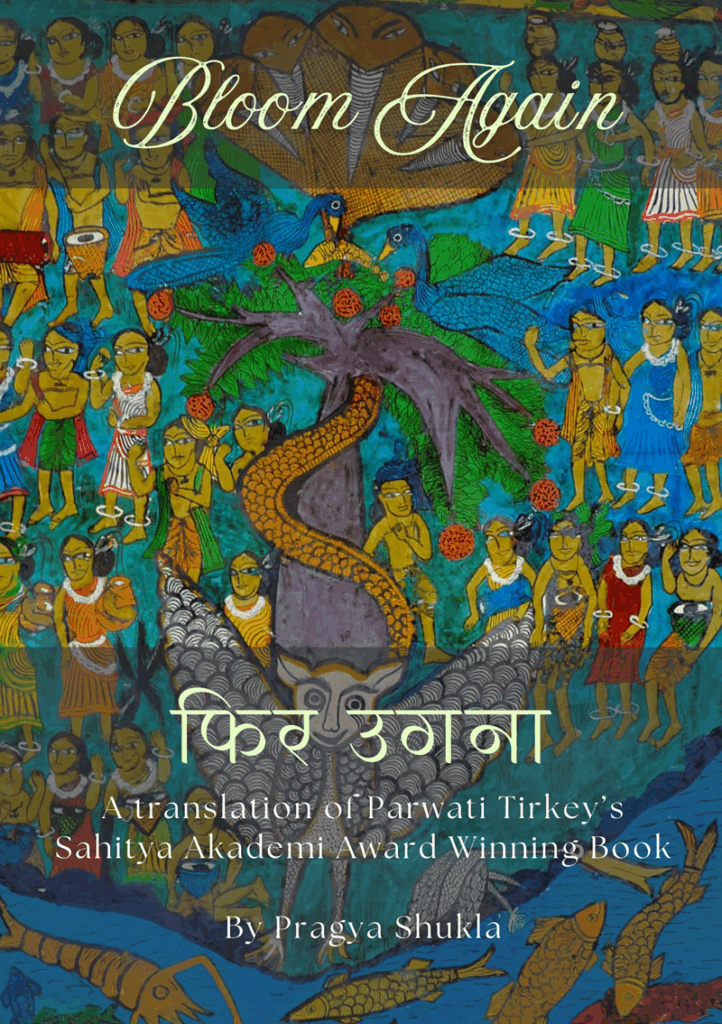
Dr Pragya Shukla has undertaken a very complex task of translating twenty-four poems written in Hindi by Anuj Lugun about “a civilization of water, forest, and land.” The civilization that Dr Lugun speaks about has been created over a vast space of the Chhotanagpur plateau region of Chhattisgarh, Odisha, Jharkhand and the western part of West Bengal. The region itself emerged out of cosmic events in the early years of the Earth. This big geological drama can still be perceived in the open theatre of nature—rugged hills, tables, swift rivers and waterfalls, red soil, unique flora and fauna. In this primordial landscape, another drama unfolds with humans occupying their place since time immemorial. The past of the ‘civilization’ can still be perceived in the rock paintings, megaliths, and cupules scattered throughout the region. At the same time, the present tries to keep up the traditions adoringly in the face of death, destruction and development.
In these regions blessed with abundant natural resources, the tale of exploitation began with the enforcement of the Brahminical ideology of segregation and marginalization. This exploitation evolved into a systematic dehumanization and criminalization during the era of British colonialism. Today, this troubling legacy persists as development models implemented post-Independence have continued to perpetuate exploitation and inequality in these lands. Interestingly, Pathalgadhi, the original Hindi poetry book, bears a symbolically significant cover by presenting a megalith with inscriptions. The megaliths of the region are originally silent with no inscriptions. Inscribing the stone artistically on the cover turns out to be a conscious act of reclaiming history.
The struggle never entered the historical record, resulting in prolonged trauma for the Adivasis of the region. These suppressed histories were assimilated in various cultural acts of resistance, like the performing arts. Oral and visual in communication, the arts have gone to the collective cultural memory of the Adivasis. Dr Anuj Lugun has drawn on these traditions; with this, his poetry has become polyphonic and multi-layered. Many voices—ancestors, male and female, nature, flora and fauna- speak through his art. The poet collects his materials from deep memory, transmitted orally and kinetically. When he puts them into poetic expressions, they turn into profound poetic messages. In some places, Lugun seems to enter a shamanic trance, uttering words of wisdom unknown to others.
Perhaps because of the profound nature of the messages, the translator felt like “partaking in a sacred act” while translating the poems. Philosophers from Plato to Coleridge talked about the shaping power of imagination, transforming an experience into an understanding. Lugun’s poetry follows the same line of the creative process in transforming into filtered expressions of “human experiences: from the strength of the resilient, the vulnerability of the marginalized, the laughter of the lively, to the despair of the victims.” Lugun’s art also seems to have been influenced by the rhythm of the Adivasi music with all its simplicity, brevity and starkness—sometimes lively and sometimes sombre.
Dr Pragya Shukla is an Assistant Professor in the Department of English Studies at the Central University of Jharkhand. Her areas of interest include Gender Studies and Tribal Literature. Her doctoral thesis focused on “A Comparative Study of the Fictional Works of Githa Hariharan and Shashi Deshpande.” In addition to research papers, she is also involved in translation and writing poetry and short stories. Email: pragya.shukla@cuj.ac.in

by Editor | Jun 17, 2026 | Book Chapter, Edited Volume, Urban Imaginaries and Indian Cities in Literature
Dr. Sudakshina Bhattacharya¹ , Dr. Sulagna Mohanty² & Dr. Ankusha Bandyopadhyay³
¹ ³Assistant Professor (Sr. Gr), Department of English & Humanities, Amrita School of Arts, Humanities & Commerce, Coimbatore, Amrita Vishwa Vidyapeetham, India. *Corresponding author.
²Assistant Professor, Department of Language, Culture and Society, Faculty of Engineering & Technology, SRM Institute of Science and Technology, Kattankulathur, Chennai.
 10.21659/9788197513022.08
Abstract
The concept of spatiality in India is continually evolving with transitions in the social, cultural, political, and economic spheres, shaping our perspectives on spatiality. India is now beginning to be recognised not only as a principally rural and agrarian country but is also attracting notice for its urban spaces and urbanity, including its innate intricacies. The Indian scholarship in this direction is proliferating in commendable ways. Apart from the critical enquiries, several writers have produced brilliant literary works about Indian cities, like Khuswant Singh, Amitav Ghosh and Mamang Dai, to name only a few. However, an extensive literature review reveals that a minimal eclectic analysis is seen about the smaller urban places in India, such as Sikkim’s capital city, Gangtok. Our study stems from this huge research gap because the process of urbanisation is happening ubiquitously in India, and hence, scholarly probes cannot be limited to the comprehension of the established Indian metropolises alone. Through an interpretive analysis of Satyajit Ray’s detective fiction Trouble in Gangtok (1971) and the documentary film titled Sikkim (1971), and Prajwal Parajuly’s novel Land Where I Flee (2014), the present research attempts to understand the urban nuances of Gangtok within the broad framework of spatial studies to highlight the existence of unique Indian urbanity.
Keywords: Spatial turn, Urbanity, Gangtok, Satyajit Ray, Prajwal Parajuly.
Full-Text Chapter PDF Full Text Book PDF
Urban Imaginaries and Indian Cities in Literature
Table of Contents
Front Matter
Urban Imaginaries and Indian Cities in Literature: An Introduction
Dr. Neethu P Antony and Dr. Arpana Venu
Abstract Full Text PDF
City as Micro-Narratives of Senses and Everyday Experiences: An Analytical Study of Selected Stories from People Called Kolkata
Olivia Joseph
Abstract Full Text PDF
Multilingual Metropolis: The Politics of Language and Belonging in Guwahati Through Sheelabhadra’s Fiction
Sangeeta Bhagawati
Abstract Full Text PDF
Spatial (re)orientations and Epic structures of the urban in Fareeda Mehta’s Kali Salwaar
Elroy Pinto
Abstract Full Text PDF
Between Tramline and Traffic Jam: Mapping Indian City through Satyajit Ray’s Mahanagar and Anurag Basu’s Life in a…Metro
Trisha Sengupta & Dr. Sanghamitra Baladhikari
Abstract Full Text PDF
Reimagining Kolkata: Subaltern Narratives and the Colonial Urban Dystopia in Kallol Magazine’s Literature
Nandini Gayen
Abstract Full Text PDF
Walking, Writing and Resisting the City: Spatial Tactics and Postcolonial Reimaginings in Janice Pariat’s Everything the Light Touches
Parvin Sultana
Abstract Full Text PDF
Mimesis, Montage and Mapping: A Spatial Analysis of Gangtok City Scapes in the Select Works of Satyajit Ray and Prajwal Parajuly
Dr. Sudakshina Bhattacharya, Dr. Sulagna Mohanty, and Dr. Ankusha Bandyopadhyay
Abstract Full Text PDF
by Editor | Jun 17, 2026 | Book Chapter, Edited Volume, Urban Imaginaries and Indian Cities in Literature
Parvin Sultana
Assistant Professor, P.B. College, Gauripur, Assam, India.
10.21659/9788197513022.07
Abstract
This paper examines Janice Pariat’s Everything the Light Touches (2022) as a complex meditation on space, memory, and decolonial resistance. It analyses the novel’s nonlinear narrative and its shifting portrayals of urban and natural landscapes and argues that Pariat constructs what Doreen Massey terms a “thrown-togetherness” of place. Her articulation of space is chaotic yet generative, marked by vitality and multiplicity. The study explores how characters inhabit postcolonial terrains through practices such as walking and dwelling at the margins, and how these acts become modes of negotiating identity. It also contends that Pariat’s fragmented storytelling mirrors the fractured condition of postcolonial subjectivity. Thus, it also opens pathways to alternative epistemologies and Indigenous knowledge systems.
Keywords: postcolonial literature, spatial theory, decolonial ecology, Indigenous epistemology, walking, place-making.
Full-Text Chapter PDF Full Text Book PDF
Urban Imaginaries and Indian Cities in Literature
Table of Contents
Front Matter
Urban Imaginaries and Indian Cities in Literature: An Introduction
Dr. Neethu P Antony and Dr. Arpana Venu
Abstract Full Text PDF
City as Micro-Narratives of Senses and Everyday Experiences: An Analytical Study of Selected Stories from People Called Kolkata
Olivia Joseph
Abstract Full Text PDF
Multilingual Metropolis: The Politics of Language and Belonging in Guwahati Through Sheelabhadra’s Fiction
Sangeeta Bhagawati
Abstract Full Text PDF
Spatial (re)orientations and Epic structures of the urban in Fareeda Mehta’s Kali Salwaar
Elroy Pinto
Abstract Full Text PDF
Between Tramline and Traffic Jam: Mapping Indian City through Satyajit Ray’s Mahanagar and Anurag Basu’s Life in a…Metro
Trisha Sengupta & Dr. Sanghamitra Baladhikari
Abstract Full Text PDF
Reimagining Kolkata: Subaltern Narratives and the Colonial Urban Dystopia in Kallol Magazine’s Literature
Nandini Gayen
Abstract Full Text PDF
Walking, Writing and Resisting the City: Spatial Tactics and Postcolonial Reimaginings in Janice Pariat’s Everything the Light Touches
Parvin Sultana
Abstract Full Text PDF
Mimesis, Montage and Mapping: A Spatial Analysis of Gangtok City Scapes in the Select Works of Satyajit Ray and Prajwal Parajuly
Dr. Sudakshina Bhattacharya, Dr. Sulagna Mohanty, and Dr. Ankusha Bandyopadhyay
Abstract Full Text PDF
by Editor | Jun 17, 2026 | Book Chapter, Edited Volume, Urban Imaginaries and Indian Cities in Literature
Nandini Gayen
Research Scholar, Department of English, Banaras Hindu University.
10.21659/9788197513022.06
Abstract
Kallol (1923-1929), a prominent literary magazine of Bengal published under the joint editorship of Dineshranjan Das and Gokulchandra Nag, became a mouthpiece for challenging the dominant Bhadralok hegemony in the Bengal Presidency. As the colonial capital and centre of modernisation, Kolkata was both a place of hope and frustration for young migrants arriving from mofussil towns in search of better lives. However, the Bhadralok account, disseminated by the city’s bourgeoisie, tended to overlook the realities experienced by the underbelly. Kallol, as a cultural and literary movement in Bengal, portrayed Kolkata as a city of stark contrasts, defined by fragmented spaces and marginalised lives. Drawing on Lefebvre’s conception of space as a political construct and Certeau’s framework of tactics versus strategies, this paper analyses how Kallol’s stories, poems, and essays expose the city’s “third spaces” of resistance, where marginalised clerks, labourers, and migrants navigate oppressive urban hierarchies. By closely reading the texts that appeared in Kallol, this article examines how the cityscape of Kolkata becomes a place where illusions of progress are subverted by economic exploitation, poverty, and the erosion of human dignity. These urbanscapes in Kallol stand not only for physiographic locations but also for psychological topographies that bring to the fore the desperation of clerks confined to demeaning jobs, labourers exploited in industrial areas, and families suffering from squalor and uncertainty. This portrayal underpins the attempt to constitute Kolkata as a fractured entity, where the relentless pace of modernisation left its residents in disconnection, disillusionment, and confinement within its dystopian boundaries. This paper will trace the contours of an uncompromised critique of Kallol in reimagining Kolkata as a dystopian space that reveals the human cost of colonial modernity and rapid urbanisation.
Keywords: Urban Dystopia, Elite Hegemony, Spatial Politics, Colonial Urbanism, Resistance, Subaltern Agency, Fragmented Cityscapes.
Full-Text Chapter PDF Full Text Book PDF
Urban Imaginaries and Indian Cities in Literature
Table of Contents
Front Matter
Urban Imaginaries and Indian Cities in Literature: An Introduction
Dr. Neethu P Antony and Dr. Arpana Venu
Abstract Full Text PDF
City as Micro-Narratives of Senses and Everyday Experiences: An Analytical Study of Selected Stories from People Called Kolkata
Olivia Joseph
Abstract Full Text PDF
Multilingual Metropolis: The Politics of Language and Belonging in Guwahati Through Sheelabhadra’s Fiction
Sangeeta Bhagawati
Abstract Full Text PDF
Spatial (re)orientations and Epic structures of the urban in Fareeda Mehta’s Kali Salwaar
Elroy Pinto
Abstract Full Text PDF
Between Tramline and Traffic Jam: Mapping Indian City through Satyajit Ray’s Mahanagar and Anurag Basu’s Life in a…Metro
Trisha Sengupta & Dr. Sanghamitra Baladhikari
Abstract Full Text PDF
Reimagining Kolkata: Subaltern Narratives and the Colonial Urban Dystopia in Kallol Magazine’s Literature
Nandini Gayen
Abstract Full Text PDF
Walking, Writing and Resisting the City: Spatial Tactics and Postcolonial Reimaginings in Janice Pariat’s Everything the Light Touches
Parvin Sultana
Abstract Full Text PDF
Mimesis, Montage and Mapping: A Spatial Analysis of Gangtok City Scapes in the Select Works of Satyajit Ray and Prajwal Parajuly
Dr. Sudakshina Bhattacharya, Dr. Sulagna Mohanty, and Dr. Ankusha Bandyopadhyay
Abstract Full Text PDF