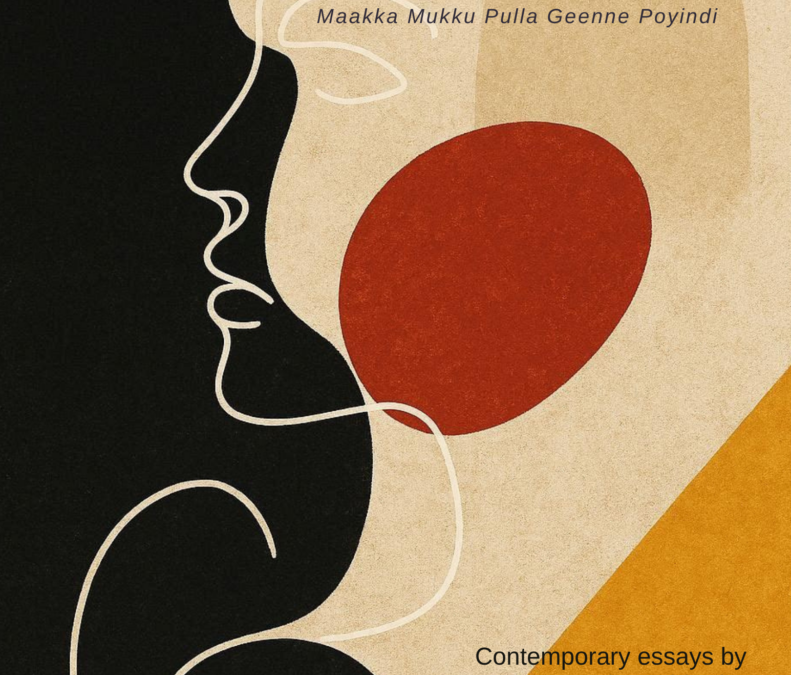
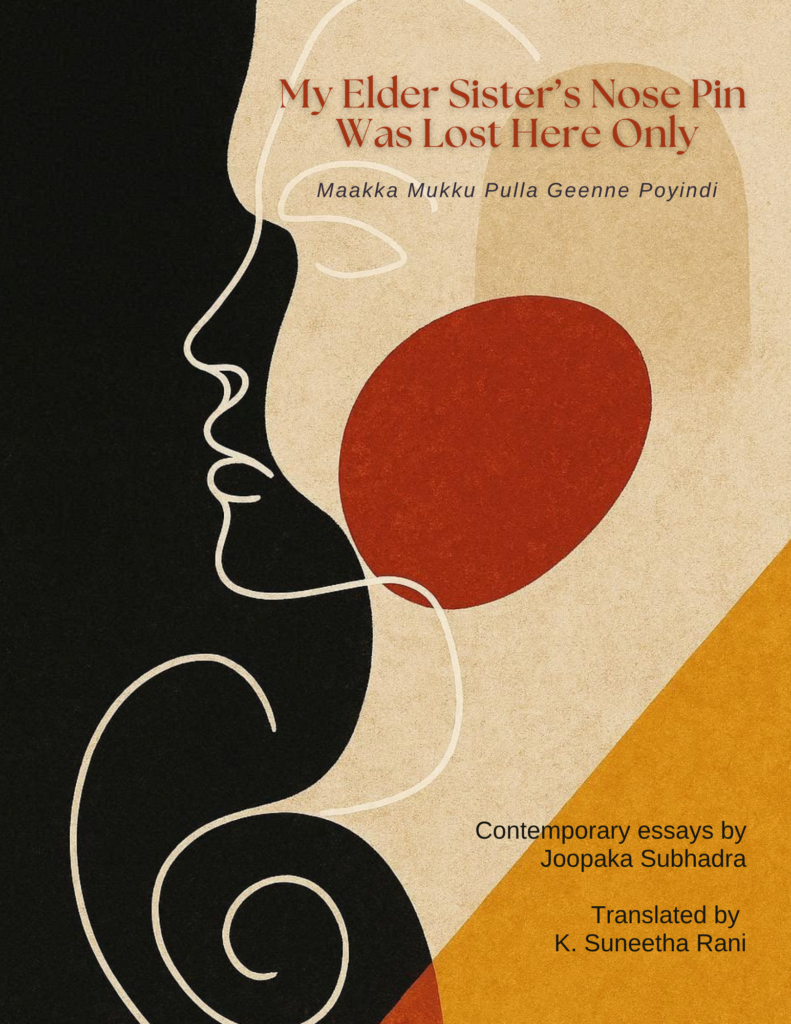
My Elder Sister’s Nose Pin Was Lost Here Only: A translation of Joopaka Subhadra’s Maakka Mukku Pulla Geenne Poyindi by K. Suneetha Rani

My Elder Sister’s Nose Pin Was Lost Here Only: A translation of Joopaka Subhadra’s Maakka Mukku Pulla Geenne Poyindi by K. Suneetha Rani

DISCOVER THE FUTURE OF ACADEMIC PUBLISHING

RUPKATHA BOOKS

My Elder Sister’s Nose Pin Was Lost Here Only: A translation of Joopaka Subhadra's Maakka Mukku Pulla Geenne Poyindi by K. Suneetha Rani

Bibliographic Details

  • Publisher: ‎ Rupkatha Books (Imprint), Aesthetix Media Services (OPC) Private Limited; First edition (06 June 2026), under Rupkatha Translation Project 2025
  • Language: ‎ English
  • Ebook: ‎ 214 pages
  • ISBN-13: ‎ 978-81-975130-0-8
  • DOI: https://doi.org/10.21659/rtp02 [to be assigned]
  • PDF Link: Free Access
  • License: CCNC
  • Dimensions: ‎ 21.59 cm x 27.94 cm
  • Country of Origin: ‎ India

About the Book

This English translation of Joopaka Subhadra’s My Elder Sister’s Nose Pin Was Lost Here Only (Ma Akka Mukku Pulla Geenne Poyindi) by K. Suneetha Rani emerges from a pressing need to re‑examine the economic, cultural, political and philosophical inheritances that dictate and control our understanding of Dalit identity and representation. Originally published as a monthly column in Bhumika Streevada Patrika (2007–2015), these writings confront the realities of caste, patriarchy, and regional marginalisation and interrogate the dynamics of power that produced such erasures. The title of the collection of essays owes its origin to a game played by children and village women, which would start with: “My elder sister’s nose pin was lost here only. Search where it was lost. Search how it was lost.” Here, “My elder sister” stands for the women of previous generations, while nose pins symbolise a prosperous, empowered cultural and theoretical stance for women.

The translation project by K. Suneetha Rani is sustained by a triadic principle of excavation, reconstruction and reclamation. Excavation involves retracing the fragments of cultural memory spread across the cultural texts, songs, myths, and philosophical motifs. Reconstruction requires reassembling these fragments into a clear canvas that brings to the fore contemporary struggles for recognition, equality, and justice. With these, it seeks to reclaim silenced histories and imagine futures grounded in the dignity of forgotten inheritances.

The collection primarily deals with the question of representation, how women, particularly those from marginalised communities, have been depicted, silenced, or mythologised in literature and cultural discourse. Figures such as Savitribai Phule, Ramabai Ambedkar, Sadalakshmi, and Phulan Devi are also remembered as icons whose lives continue to inspire. Subhadra situates their legacies alongside contemporary battles, showing how past and present are bound together in the ongoing fight for dignity and equality. She is acutely aware of the intersectionality involved in women’s representation and shows how oppression operates through overlapping structures by linking caste, class, gender, sexuality and religion.

Ultimately, this book invites all to participate in the ongoing dialogue about memory, representation and justice. It proves that the humanities remain vital precisely because they help us grapple with the unfinished business of history, and because they offer tools for imagining more equitable futures. In this, it turns into a manifesto of resistance and a call to rethink democracy through the eyes of the oppressed. My Elder Sister’s Nose Pin Was Lost Here Only offers a searing journey into the politics of caste and gender in contemporary India.

About the Author

About the Author

Joopaka Subhadra is a Dalit womanist writer and activist who has published extensively in Telugu, including essays, columns, short fiction, and poetry. She has edited anthologies, translated fiction into Telugu, and served on the editorial committees of various journals and magazines. Her works include Ayyayyo Dammakka, a collection of poems (2009); Rayakka Manyam, a collection of short stories (2014); Charitralni Cherigipostu, a collection of essays on literary criticism (2021); Reservation Bogie, a collection of short stories (2021); Telangani Kaitala Donthulu, a collection of poems (2024). Subhadra has translated the Tamil Dalit writer Bama’s book Sangati into Telugu as Sangathi. She was honoured with almost 40 awards, including the Best Writer Award from the Telangana State Government. She has been writing a column titled Gunugupulu in the Sunday Supplement of the Telugu daily Andhra Jyothi since July 2023. My Elder Sister’s Nose Pin was Lost Here Only is the English translation of a column titled Ma Akka Mukku Pulla Geenne Poyindi, written by Joopaka Subhadra for Bhumika Streevada Patrika, a Telugu feminist monthly journal, from 2007 to 2015. The column is a critical commentary on various issues related to society, politics, and movements, but focusing on the marginalised identities such as caste, gender, and region.

About the Translator

About the Translator

K. Suneetha Rani is a Professor at the Centre for Women’s Studies, University of Hyderabad. Currently, she is the Dean of the School of Social Sciences. She was with the Department of English for 16 years before joining the Centre for Women’s Studies in 2011. Her areas of interest include Gender Studies, Cultural Studies, Comparative Studies, New Literatures in English, Translation Studies and Feminist Pedagogy. Her PhD in English Literature is on Australian Aboriginal Women’s Autobiographies. She translates from Telugu to English and English to Telugu. She has extensively published research articles and translations in English and Telugu. Her major publications in English include Australian Aboriginal Women’s Autobiographies: A Critical Study (2006), Flowering from the Soil: Dalit Women’s Writing from Telugu (Translation of Dalit Women’s Select Writings from Telugu) (2012), English in the Dalit Context (co-editor) (2014), Vibhinna: Voices from Contemporary Telugu Writing ((co-editor) (2015), A House on the Outskirts and Other Stories (Translation of Devarakonda Balagangadhara Tilak’s select short fiction from Telugu)(2016), Influence of English on Indian Women Writers: Voices from the Regional Languages (2017), Identities and Assertions: Dalit Women’s Narratives (2017), The Rock That Was Not (Translation of Githanjali’s Select Short Fiction from Telugu) (2019), Critical Discourse in Telugu (2021). Her book-length translations into Telugu include Neeli Needa: Australia Adivasi Ammayi Atmakatha; Daarulu: Tappinchukune Daarulu, and Dweeparagalu: Srilanka Strila Sahityam. She is the editor of Gender Handbooks in Telugu and English for teachers and students of 6-8 and 9-12 classes assigned by Samagra Shiksha, Telangana and funded by UNICEF. She is the President of the Executive Committee of Bhumika Women’s Collective, Hyderabad, a non-profit organisation working against gender-based violence. She has recently completed a research project on gender assumptions among adolescent boys, assigned by the Department of Education, Government of Telangana, and funded by UNICEF, Telangana.

Get In Touch

Rupkatha Books, a leading academic publisher, invites you to submit your book proposal for open access publication. We are dedicated to advancing scholarship by releasing high-quality books that are meticulously curated and freely accessible to ensure knowledge is shared without barriers. Our Book Processing Charges (BPC) depend on the nature of the books and are negotiable. The chapter Processing Charge (CPC) for a 5,000-word chapter is set at 100 USD.
Bloom Again

Bloom Again

DISCOVER THE FUTURE OF ACADEMIC PUBLISHING

RUPKATHA BOOKS

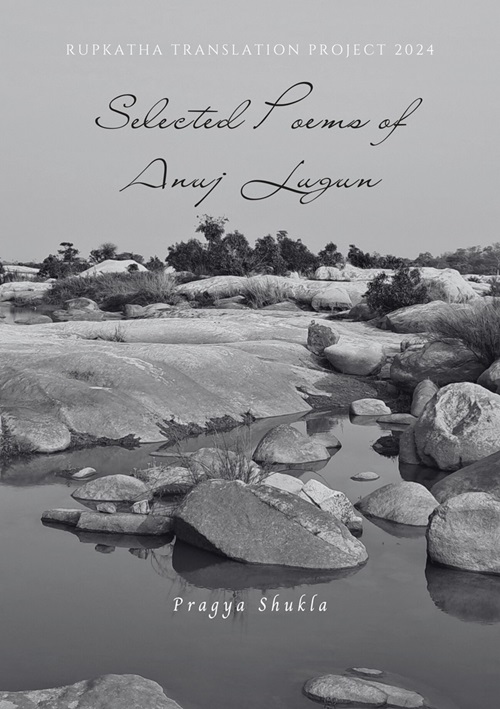
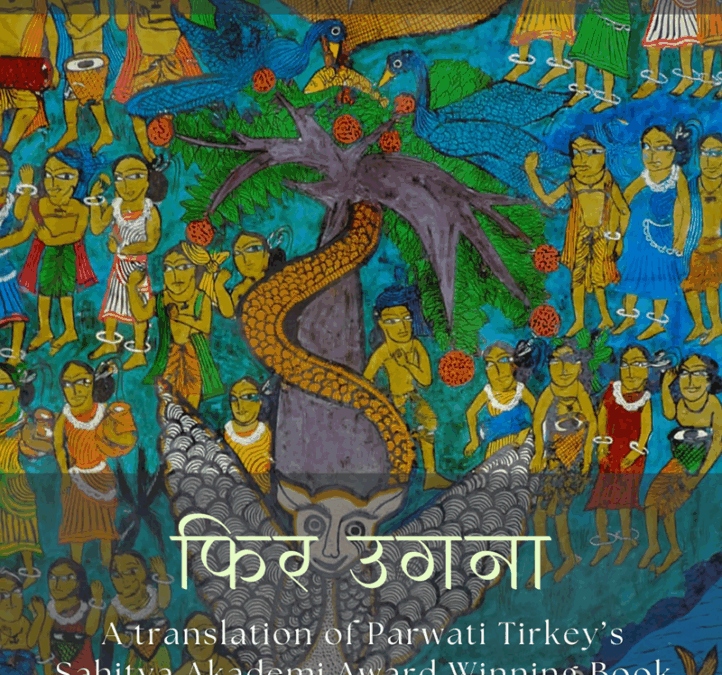
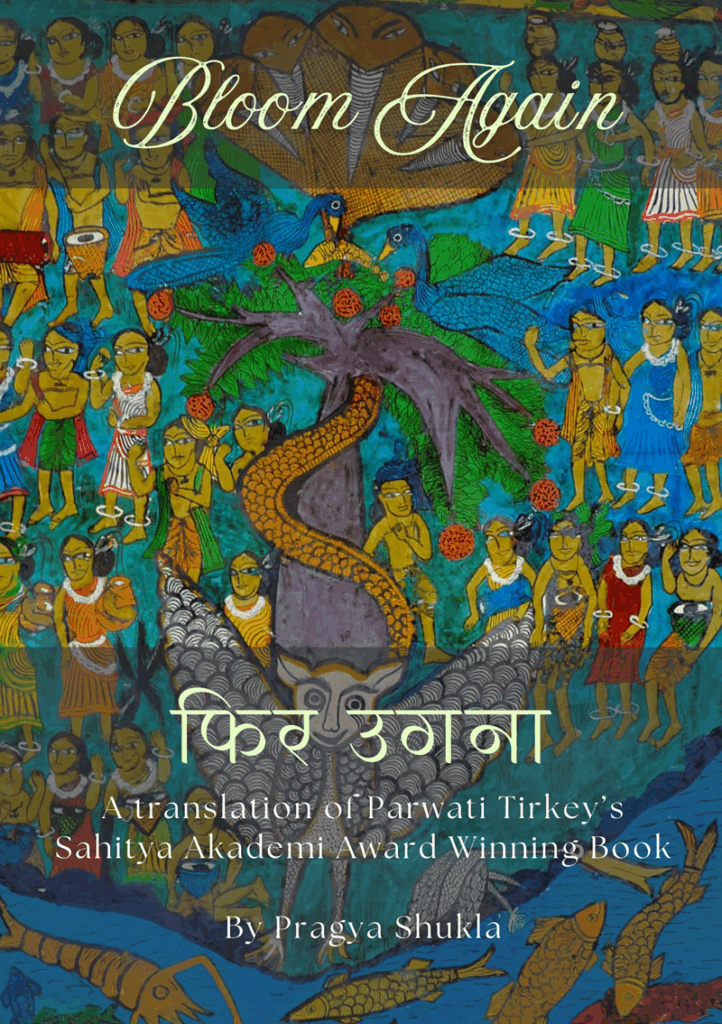
Bloom Again: A translation of Dr Parwati Tirkey’s Sahitya Akademi Award Winning Book by Dr Pragya Shukla

Bibliographic Details

  • Publisher: ‎ Rupkatha Books (Imprint), Aesthetix Media Services (OPC) Private Limited; First edition (21 September 2025), under Rupkatha Translation Project 2025
  • Language: ‎ English
  • Ebook: ‎ 154 pages
  • ISBN-13: ‎ 978-81-975130-9-1
  • DOI: https://doi.org/10.21659/rtp02
  • PDF Link: Free Access
  • License: CCNC
  • Dimensions: ‎ 17.6 cm x 25 cm
  • Country of Origin: ‎ India

About the Book

True poetry leaves a permanent intellectual impact on the mind of a dedicated reader. This is true about the first collection of poems by Dr Parwati Tirkey, Phir Ugna (2023), published by Rajkamal Prakashan, which has earned her the Sahitya Akademi Yuva Puraskar 2025. She has emerged as one of the evocative poetic voices in Hindi from the Indigenous communities of Jharkhand. Born on 16 January 1994 in Gumla district, Jharkhand, Parvati Tirkey received early education at Jawahar Navodaya Vidyalaya, Gumla. She pursued graduation and post-graduation in Hindi literature at Banaras Hindu University, Varanasi, where she later earned a PhD from the Hindi Department on the topic “Kudukh Adivasi Songs: Life Raga and Life Struggle in Hindi.” During her time at Banaras Hindu University (BHU), she remained deeply connected to her tribal culture, supported by peers who upheld their traditions, while observing some of them becoming detached from their roots. She ascribes this disconnection to several reasons: the urban upbringing, the erosion of village structures, and the lack of access to Indigenous knowledge systems. So, she saw many being swept into a competitive societal race without ever experiencing the depth of tribal life. Her university years, however, deepened her connection to village life and her tribal identity. She described village life as embodying love, warmth, empathy, and a sense of egalitarianism that stood in contrast to hierarchical norms. For Tirkey, literature was deeply ingrained in her family and the tribal community: her parents have always been deeply connected to their communal literary traditions, where ancestral literature is preserved through performance.

Tirkey’s collection draws inspiration from the rhythms of the forest, the sounds of birds and rivers, the wisdom of ancestors, and a living cosmology. Writing in a voice that is both intimate and expansive, her poetry invites readers to witness the sacred in everyday affairs and to renegotiate relationships with the land, its members, and the invisible threads of heritage. What sets Tirkey apart is her ability to translate Indigenous cosmology into contemporary poetic form without losing its spirit. She builds her art on a vision that explores contemporary times through the lens of ecological crisis and cultural amnesia.

Translating such a textured and spiritually resonant body of work is no small feat, and Dr Pragya Shukla has undertaken this task with both reverence and rigour. For Dr Shukla, the act of translation as a linguistic endeavour becomes a voyage into the core of an Indigenous worldview. She exerted every effort to maintain the original rhythm and breath of the poems so that readers might feel the heartbeat of the land, hear the voices of its people, and experience the sacred textures of a culture that is often overlooked yet profoundly alive.

Also available on
[ba_logo_carousel slide_count=”2″ logo_height=”60px” _builder_version=”4.27.4″ _module_preset=”default” global_colors_info=”{}”][ba_logo_carousel_child logo=”https://rupkatha.com/books/wp-content/uploads/2025/02/Screenshot-2025-02-11-181649.png” is_link=”on” link_url=”https://play.google.com/store/books/details?id=CbpGEQAAQBAJ” link_options=”on|off” _builder_version=”4.27.4″ _module_preset=”default” global_colors_info=”{}”][/ba_logo_carousel_child][ba_logo_carousel_child logo=”https://rupkatha.com/books/wp-content/uploads/2025/02/amazon-kindle-1-768×3362-1.jpg” is_link=”on” link_url=”https://www.amazon.in/dp/B0DY322NHF?ref=cm_sw_r_ffobk_mwn_dp_T914PTCM82QG8729EG7Q&ref_=cm_sw_r_ffobk_mwn_dp_T914PTCM82QG8729EG7Q&social_share=cm_sw_r_ffobk_mwn_dp_T914PTCM82QG8729EG7Q&language=en-IN&bestFormat=true&fbclid=IwY2xjawIuJtlleHRuA2FlbQIxMAABHfMjysJbYWACzEBBXFfn40IvFHSCtAOTxkMubmHpSk3oNqQiP7X4SLWrBQ_aem_Q4yLC2l2Yp5iA-LwJL3LvQ” link_options=”on|off” _builder_version=”4.27.4″ _module_preset=”default” global_colors_info=”{}”][/ba_logo_carousel_child][/ba_logo_carousel]
About the Translator

About the Translator

Dr Pragya Shukla is an Assistant Professor in the Department of English Studies at the Central University of Jharkhand. Her areas of interest include Gender Studies and Tribal Literature. Her doctoral thesis focused on “A Comparative Study of the Fictional Works of Githa Hariharan and Shashi Deshpande.” In addition to research papers, she is also involved in translation and writing poetry and short stories.  Email: pragya.shukla@cuj.ac.in

Get In Touch

Rupkatha Books, a leading academic publisher, invites you to submit your book proposal for open access publication. We are dedicated to advancing scholarship by releasing high-quality books that are meticulously curated and freely accessible to ensure knowledge is shared without barriers. Our Book Processing Charges (BPC) depend on the nature of the books and are negotiable. The chapter Processing Charge (CPC) for a 5,000-word chapter is set at 100 USD.
RUPKATHA BOOKS

RUPKATHA BOOKS

DISCOVER THE FUTURE OF ACADEMIC PUBLISHING

RUPKATHA BOOKS

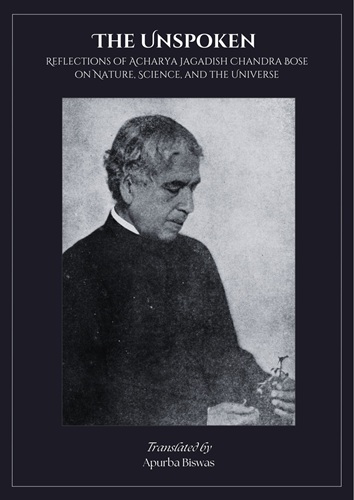
The Unspoken: Reflections of Acharya Jagadish Chandra Bose on Nature, Science, and the Universe

A translation of Jagadish Chandra Bose’s Abyakta
By Apurba Biswas

Bibliographic Details

  • Publisher: ‎ Rupkatha Books (Imprint), Aesthetix Media Services (OPC) Private Limited; First edition (5 February 2025), under Rupkatha Translation Project 2025
  • Language: ‎ English
  • Ebook: ‎ 116 pages
  • ISBN-13: ‎ 978-81-975130-1-5
  • DOI: https://doi.org/10.21659/rtp02
  • PDF Link: Free Access
  • License: CCNC
  • Dimensions: ‎ 17.6 cm x 25 cm
  • Country of Origin: ‎ India

About the Book

What lies beyond the seen and the known? How does the universe whisper its secrets in the language of waves, vibrations, and the silent pulse of existence? The Unspoken: Reflections of Acharya Jagadish Chandra Bose on Nature, Science, and the Universe is a luminous voyage into the mind of Acharya Jagadish Chandra Bose, the pioneering scientist-poet-philosopher whose vision defied the rigid boundaries between science and the humanities.
Apurba Biswas presents an extraordinary ‘transcreation’ of Abyakta, Bose’s collection of essays that merge scientific inquiry with poetic reflection, empirical rigor with metaphysical wonder. This ‘transcreation’ is not merely a linguistic rendering but an intellectual reawakening—an invitation to traverse the uncharted terrain of Bose’s thoughts on nature, consciousness, and the hidden forces that bind the cosmos.
With an eloquence that mirrors Bose’s own lyrical meditations, The Unspoken reveals the unseen symphony of existence—where electromagnetic waves converse with the human soul, where trees whisper the stories of time, and where the very fabric of reality is woven with unseen energies.
At a time when knowledge is increasingly compartmentalized, Bose’s vision is a clarion call for unity—between disciplines, between cultures, between the empirical and the ineffable. Whether you are a scientist, philosopher, student, or seeker of wisdom, this book will ignite your curiosity and challenge the way you perceive the universe. Enter the world, be prepared to step beyond the visible and ‘listen’ to The Unspoken.

Also available freely on
[ba_logo_carousel slide_count=”2″ logo_height=”60px” _builder_version=”4.27.4″ _module_preset=”default” hover_enabled=”0″ global_colors_info=”{}” sticky_enabled=”0″][ba_logo_carousel_child logo=”https://rupkatha.com/books/wp-content/uploads/2025/02/Screenshot-2025-02-11-181649.png” is_link=”on” link_url=”https://play.google.com/store/books/details?id=CbpGEQAAQBAJ” link_options=”on|off” _builder_version=”4.27.4″ _module_preset=”default” global_colors_info=”{}”][/ba_logo_carousel_child][ba_logo_carousel_child logo=”https://rupkatha.com/books/wp-content/uploads/2025/02/amazon-kindle-1-768×3362-1.jpg” _builder_version=”4.27.4″ _module_preset=”default” hover_enabled=”0″ global_colors_info=”{}” is_link=”on” link_url=”https://www.amazon.in/dp/B0DY322NHF?ref=cm_sw_r_ffobk_mwn_dp_T914PTCM82QG8729EG7Q&ref_=cm_sw_r_ffobk_mwn_dp_T914PTCM82QG8729EG7Q&social_share=cm_sw_r_ffobk_mwn_dp_T914PTCM82QG8729EG7Q&language=en-IN&bestFormat=true&fbclid=IwY2xjawIuJtlleHRuA2FlbQIxMAABHfMjysJbYWACzEBBXFfn40IvFHSCtAOTxkMubmHpSk3oNqQiP7X4SLWrBQ_aem_Q4yLC2l2Yp5iA-LwJL3LvQ” link_options=”on|off” sticky_enabled=”0″][/ba_logo_carousel_child][/ba_logo_carousel]
About the Translator

About the Translator

Apurba Biswas is a doctoral candidate at the School of Humanities and Social Sciences, National Institute of Science Education and Research (NISER), an Off-Campus Centre (OCC) of Homi Bhabha National Institute. His research spans Translation Studies, Sociolinguistics, Urban Studies, Archetypal Psychology, and Sufi Studies. With an avid interest in ‘transcreation,’ Biswas bridges linguistic and intellectual traditions, rendering significant philosophical and literary writings accessible to a global audience—a principle exemplified in The Unspoken: Reflections of Acharya Jagadish Chandra Bose on Nature, Science, and the Universe. His adept ‘re-manifestation’ of Bose’s Abyakta seeks to dissolve boundaries between disciplines and perspectives and promote a more holistic understanding of knowledge. Biswas encourages readers to explore the junctions of theory, curiosity, and discovery by cultivating connections across disciplines, languages, and cultures. Email: apurba.biswas@niser.ac.in, biswas.acad@gmail.com

Get In Touch

Rupkatha Books, a leading academic publisher, invites you to submit your book proposal for open access publication. We are dedicated to advancing scholarship by releasing high-quality books that are meticulously curated and freely accessible to ensure knowledge is shared without barriers. Our Book Processing Charges (BPC) depend on the nature of the books and are negotiable. The chapter Processing Charge (CPC) for a 5,000-word chapter is set at 100 USD.