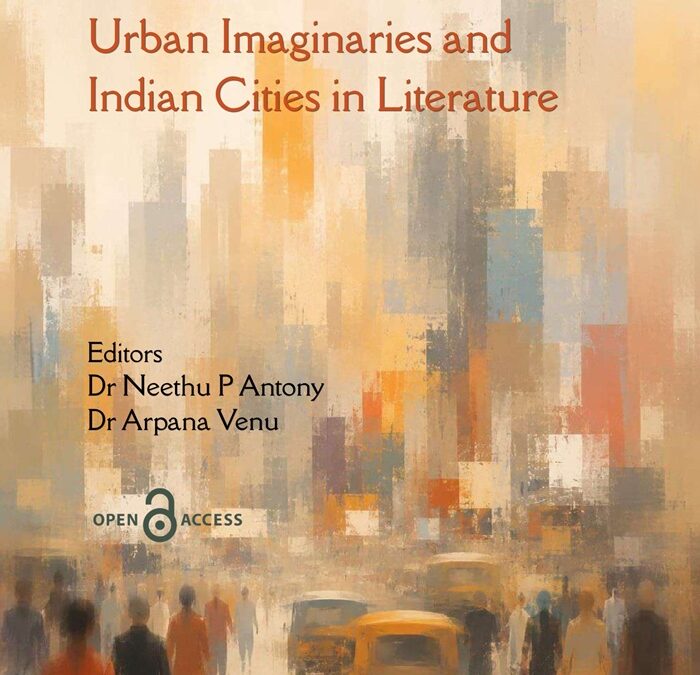
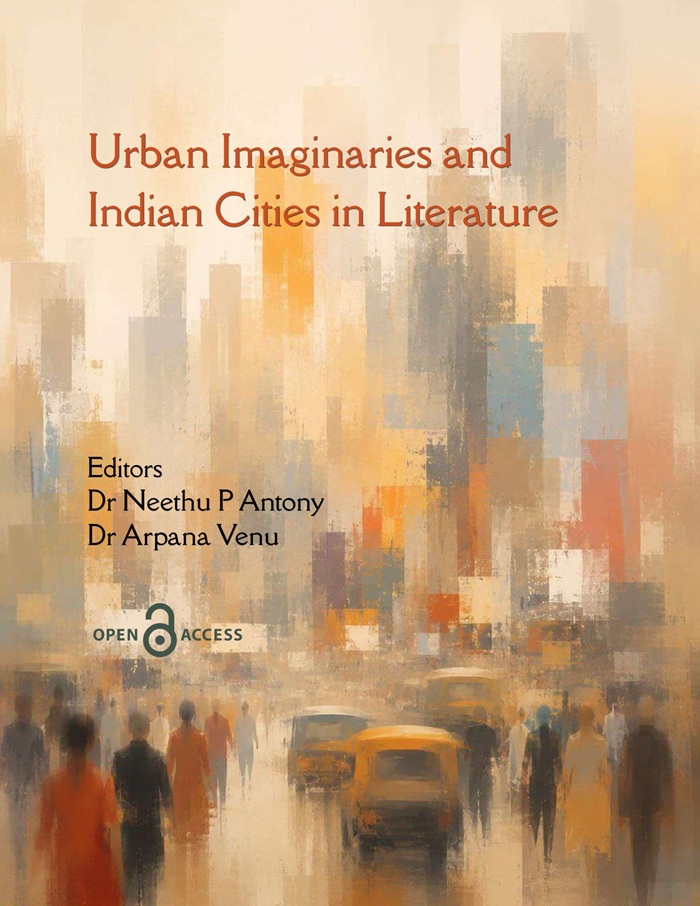
Urban Imaginaries and Indian Cities in Literature

Urban Imaginaries and Indian Cities in Literature

DISCOVER THE FUTURE OF ACADEMIC PUBLISHING

RUPKATHA BOOKS

Urban Imaginaries and Indian Cities in Literature

Bibliographic Details

  • Publisher: ‎ Rupkatha Books (Imprint), Aesthetix Media Services (OPC) Private Limited; First edition (19 June 2026)
  • Language: ‎ English
  • Ebook: ‎ 103 pages
  • ISBN-13: ‎ 978-81-975130-2-2
  • DOI: https://doi.org/10.21659/9788197513022
  • PDF Link: Free Access
  • License: CCNC
  • Dimensions: ‎ 21.59 cm x 27.94 cm
  • Country of Origin: ‎ India
  • Book Citation: Antony, N. P., & Venu, A. (Eds.). (2026). Urban imaginaries and Indian cities in literature. Rupkatha Books. ISBN: 978-81-975130-2-2. https://doi.org/10.21659/9788197513022

About the Book

Urban Imaginaries and Indian Cities in Literature examines the multiple modes of representation, contestation and re-imagination of Indian cities in literary texts and cultural discourses. The volume explores the role of urban spaces not only as backdrops, but as active forces in the construction of human life and social relations. It attempts to understand how literature depicts the tensions between tradition and modernity, memory and progress, inclusion and exclusion and local and global forces that characterise contemporary urban life. The chapters in this collection address a broad spectrum of themes such as urban marginalisation, migration, gendered experiences, environmental issues, spatial politics, memory, and imagined futures. Drawing on several theoretical and methodological dimensions, the contributors illuminate the complexities and challenges of urban life in India. This volume constitutes eight chapters that do not provide a comprehensive study of major metropolitan Indian cities as often seen in the existing corpus of urban studies. The present chapter makes the case that it is rather an attempt to bring unique representations of known and unknown urban spaces in India to unravel the way the various urban spaces are imagined, experienced, contested, represented and negotiated across different historical, social, and cultural contexts in India. The recurrence of certain cities like Kolkata in the volume does not offer a singular narrative of its urban space. Instead, it focuses on the broader dimensions of the same city with its multiple urban experiences and posits ‘urbanity’ as an evolving and dynamic process.


Table of Contents


Front Matter


Urban Imaginaries and Indian Cities in Literature: An Introduction

Dr. Neethu P Antony and Dr. Arpana Venu

Abstract Full Text PDF


City as Micro-Narratives of Senses and Everyday Experiences: An Analytical Study of Selected Stories from People Called Kolkata

Olivia Joseph

Abstract Full Text PDF


Multilingual Metropolis: The Politics of Language and Belonging in Guwahati Through Sheelabhadra’s Fiction

Sangeeta Bhagawati

Abstract Full Text PDF


Spatial (re)orientations and Epic structures of the urban in Fareeda Mehta’s Kali Salwaar

Elroy Pinto

Abstract Full Text PDF


Between Tramline and Traffic Jam: Mapping Indian City through Satyajit Ray’s Mahanagar and Anurag Basu’s Life in a…Metro

Trisha Sengupta & Dr. Sanghamitra Baladhikari

Abstract Full Text PDF


Reimagining Kolkata: Subaltern Narratives and the Colonial Urban Dystopia in Kallol Magazine’s Literature

Nandini Gayen

Abstract Full Text PDF


Walking, Writing and Resisting the City: Spatial Tactics and Postcolonial Reimaginings in Janice Pariat’s Everything the Light Touches

Parvin Sultana

Abstract Full Text PDF


Mimesis, Montage and Mapping: A Spatial Analysis of Gangtok City Scapes in the Select Works of Satyajit Ray and Prajwal Parajuly

Dr. Sudakshina Bhattacharya, Dr. Sulagna Mohanty, and Dr. Ankusha Bandyopadhyay

Abstract Full Text PDF


About the Editors

About the Editors

Dr Neethu P. Antony is an Assistant Professor of English at the School of Social Sciences and Humanities (VISH), VIT-AP University, Andhra Pradesh, India. She holds a PhD in English Literature from Mahatma Gandhi University, Kerala, specialising in Gender, Performance, and Theatre Studies. Her research explores theatre and drama, subaltern resistance, trauma theory, gender and performance studies, urban space theory, and communication studies. She has published extensively on voice studies, Indian theatre modernity, ekphrastic literature, gender fluidity, and urbanism, and has presented her work at numerous national and international conferences.

Dr Arpana Venu is an Assistant Professor of English at the School of Humanities and Social Sciences, VIT-AP University, Andhra Pradesh. She holds her doctoral degree from Amrita Vishwa Vidyapeetham, with a focus on Intra-Asian Travel Writing. Her research interests include travel writing, South-Asian studies, urban studies, bhasha literature and film studies. She has published and presented her research at various national and international conferences. Additionally, she is interested in translation, Indian classical music and interdisciplinary collaborative research.

Get In Touch

Rupkatha Books, a leading academic publisher, invites you to submit your book proposal for open access publication. We are dedicated to advancing scholarship by releasing high-quality books that are meticulously curated and freely accessible to ensure knowledge is shared without barriers. Our Book Processing Charges (BPC) depend on the nature of the books and are negotiable. The chapter Processing Charge (CPC) for a 5,000-word chapter is set at 100 USD.
Bloom Again

Bloom Again

DISCOVER THE FUTURE OF ACADEMIC PUBLISHING

RUPKATHA BOOKS

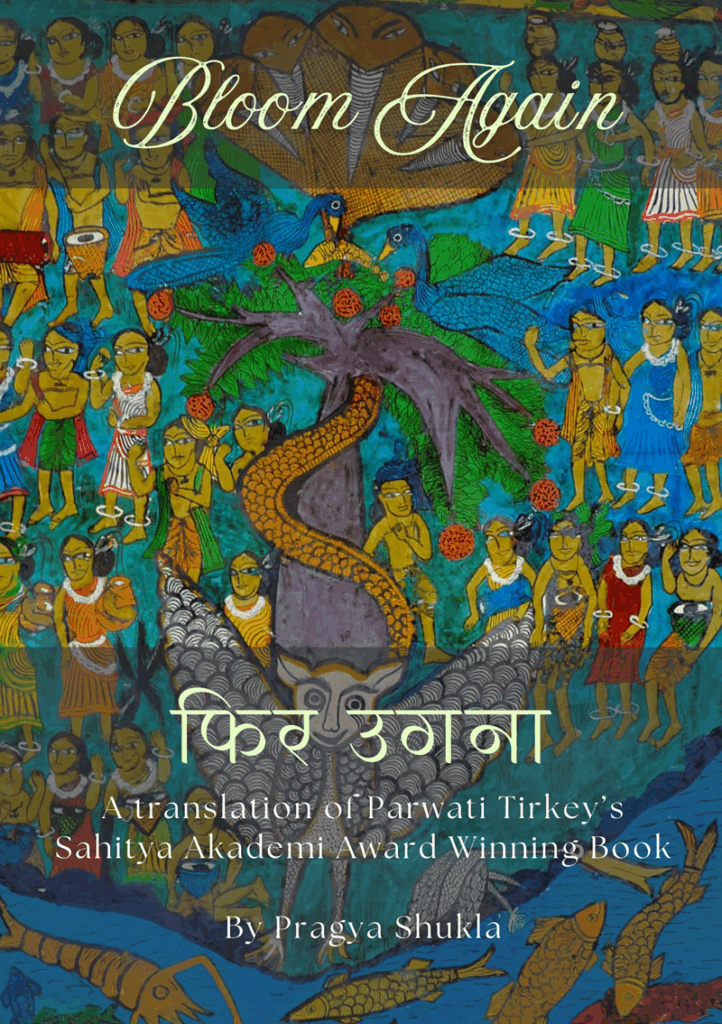
Bloom Again: A translation of Dr Parwati Tirkey’s Sahitya Akademi Award Winning Book by Dr Pragya Shukla

Bibliographic Details

  • Publisher: ‎ Rupkatha Books (Imprint), Aesthetix Media Services (OPC) Private Limited; First edition (21 September 2025), under Rupkatha Translation Project 2025
  • Language: ‎ English
  • Ebook: ‎ 154 pages
  • ISBN-13: ‎ 978-81-975130-9-1
  • DOI: https://doi.org/10.21659/rtp02
  • PDF Link: Free Access
  • License: CCNC
  • Dimensions: ‎ 17.6 cm x 25 cm
  • Country of Origin: ‎ India

About the Book

True poetry leaves a permanent intellectual impact on the mind of a dedicated reader. This is true about the first collection of poems by Dr Parwati Tirkey, Phir Ugna (2023), published by Rajkamal Prakashan, which has earned her the Sahitya Akademi Yuva Puraskar 2025. She has emerged as one of the evocative poetic voices in Hindi from the Indigenous communities of Jharkhand. Born on 16 January 1994 in Gumla district, Jharkhand, Parvati Tirkey received early education at Jawahar Navodaya Vidyalaya, Gumla. She pursued graduation and post-graduation in Hindi literature at Banaras Hindu University, Varanasi, where she later earned a PhD from the Hindi Department on the topic “Kudukh Adivasi Songs: Life Raga and Life Struggle in Hindi.” During her time at Banaras Hindu University (BHU), she remained deeply connected to her tribal culture, supported by peers who upheld their traditions, while observing some of them becoming detached from their roots. She ascribes this disconnection to several reasons: the urban upbringing, the erosion of village structures, and the lack of access to Indigenous knowledge systems. So, she saw many being swept into a competitive societal race without ever experiencing the depth of tribal life. Her university years, however, deepened her connection to village life and her tribal identity. She described village life as embodying love, warmth, empathy, and a sense of egalitarianism that stood in contrast to hierarchical norms. For Tirkey, literature was deeply ingrained in her family and the tribal community: her parents have always been deeply connected to their communal literary traditions, where ancestral literature is preserved through performance.

Tirkey’s collection draws inspiration from the rhythms of the forest, the sounds of birds and rivers, the wisdom of ancestors, and a living cosmology. Writing in a voice that is both intimate and expansive, her poetry invites readers to witness the sacred in everyday affairs and to renegotiate relationships with the land, its members, and the invisible threads of heritage. What sets Tirkey apart is her ability to translate Indigenous cosmology into contemporary poetic form without losing its spirit. She builds her art on a vision that explores contemporary times through the lens of ecological crisis and cultural amnesia.

Translating such a textured and spiritually resonant body of work is no small feat, and Dr Pragya Shukla has undertaken this task with both reverence and rigour. For Dr Shukla, the act of translation as a linguistic endeavour becomes a voyage into the core of an Indigenous worldview. She exerted every effort to maintain the original rhythm and breath of the poems so that readers might feel the heartbeat of the land, hear the voices of its people, and experience the sacred textures of a culture that is often overlooked yet profoundly alive.

Also available on
[ba_logo_carousel slide_count=”2″ logo_height=”60px” _builder_version=”4.27.4″ _module_preset=”default” global_colors_info=”{}”][ba_logo_carousel_child logo=”https://rupkatha.com/books/wp-content/uploads/2025/02/Screenshot-2025-02-11-181649.png” is_link=”on” link_url=”https://play.google.com/store/books/details?id=CbpGEQAAQBAJ” link_options=”on|off” _builder_version=”4.27.4″ _module_preset=”default” global_colors_info=”{}”][/ba_logo_carousel_child][ba_logo_carousel_child logo=”https://rupkatha.com/books/wp-content/uploads/2025/02/amazon-kindle-1-768×3362-1.jpg” is_link=”on” link_url=”https://www.amazon.in/dp/B0DY322NHF?ref=cm_sw_r_ffobk_mwn_dp_T914PTCM82QG8729EG7Q&ref_=cm_sw_r_ffobk_mwn_dp_T914PTCM82QG8729EG7Q&social_share=cm_sw_r_ffobk_mwn_dp_T914PTCM82QG8729EG7Q&language=en-IN&bestFormat=true&fbclid=IwY2xjawIuJtlleHRuA2FlbQIxMAABHfMjysJbYWACzEBBXFfn40IvFHSCtAOTxkMubmHpSk3oNqQiP7X4SLWrBQ_aem_Q4yLC2l2Yp5iA-LwJL3LvQ” link_options=”on|off” _builder_version=”4.27.4″ _module_preset=”default” global_colors_info=”{}”][/ba_logo_carousel_child][/ba_logo_carousel]
About the Translator

About the Translator

Dr Pragya Shukla is an Assistant Professor in the Department of English Studies at the Central University of Jharkhand. Her areas of interest include Gender Studies and Tribal Literature. Her doctoral thesis focused on “A Comparative Study of the Fictional Works of Githa Hariharan and Shashi Deshpande.” In addition to research papers, she is also involved in translation and writing poetry and short stories.  Email: pragya.shukla@cuj.ac.in

Get In Touch

Rupkatha Books, a leading academic publisher, invites you to submit your book proposal for open access publication. We are dedicated to advancing scholarship by releasing high-quality books that are meticulously curated and freely accessible to ensure knowledge is shared without barriers. Our Book Processing Charges (BPC) depend on the nature of the books and are negotiable. The chapter Processing Charge (CPC) for a 5,000-word chapter is set at 100 USD.